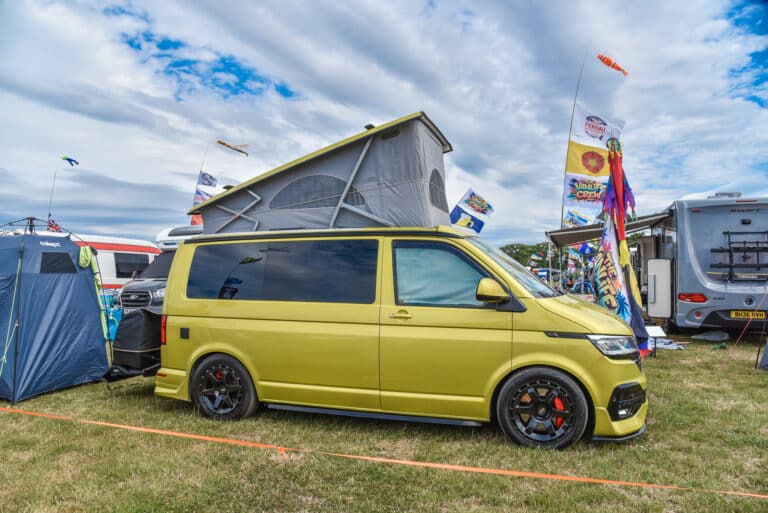
Buying a used campervan is exciting, particularly if it is your first. You are probably already imagining weekends away, coastal adventures, festivals and waking up somewhere with a rather better view than your driveway.
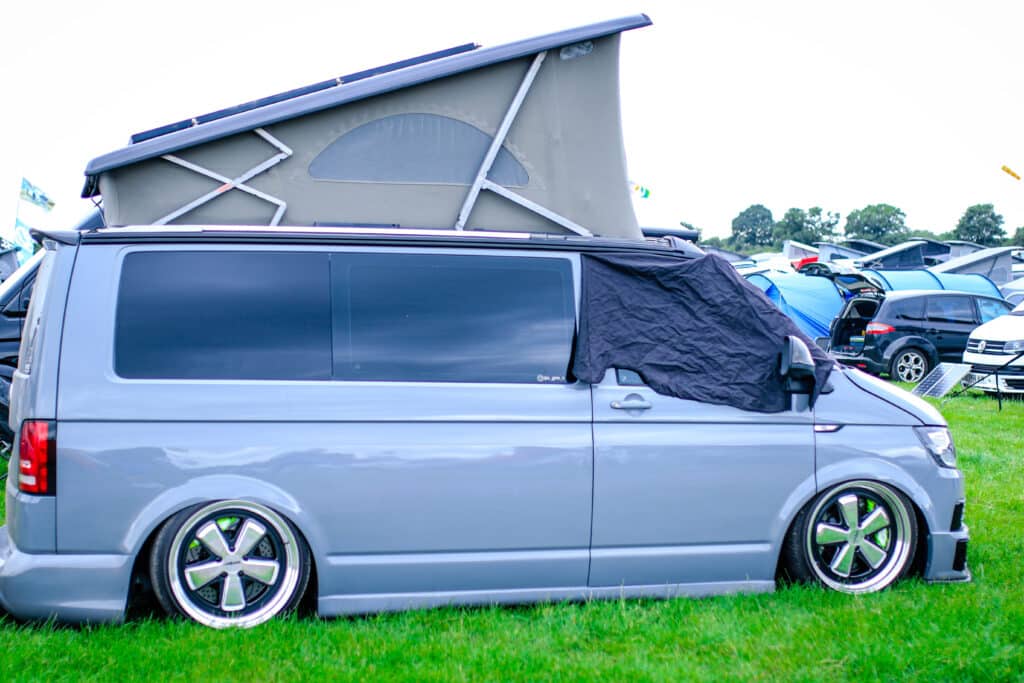
However, buying a campervan is slightly more complicated than buying an ordinary car. You are buying both a vehicle and a small home, complete with its own electrical equipment, furniture, heating and potentially gas and water systems.
Our used campervan buying checklist will help you understand what to look for, what questions to ask and which potential problems deserve further investigation before you hand over your money.
Although we love our Volkswagens at Dubbed Out, this guide applies to most makes of campervan, including professionally converted vehicles, factory-built campers and self-builds.
Download Your Free Used Campervan Buying Checklist
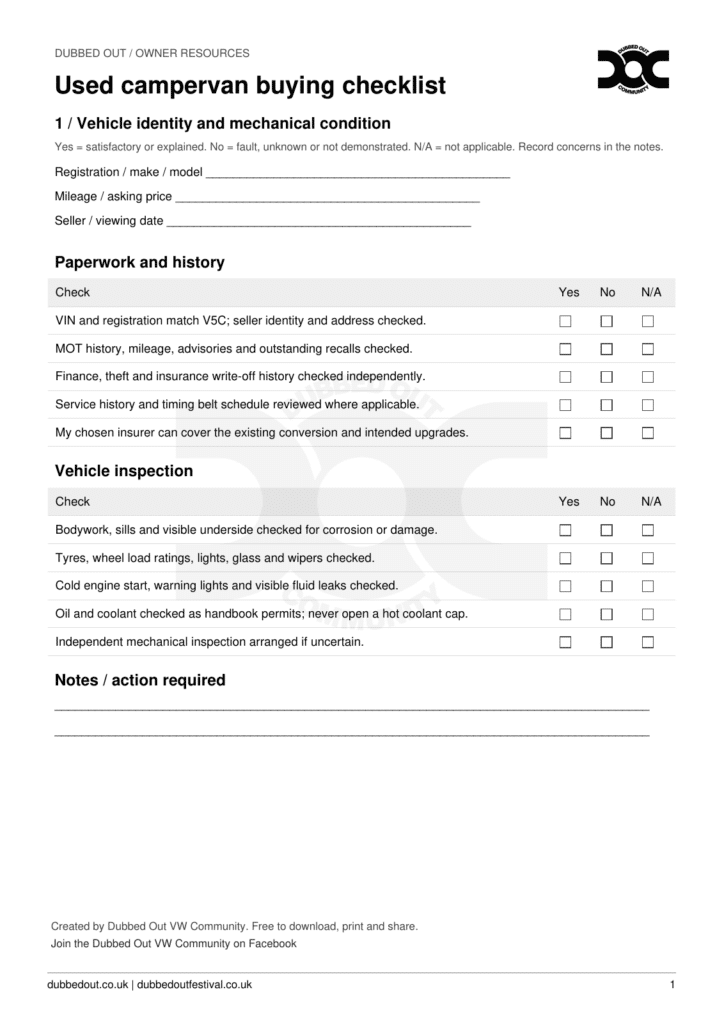
Take our free five-page printable checklist with you when viewing a campervan. It includes vehicle checks, conversion checks, questions for the seller, equipment demonstrations, repair estimates and space for your own notes.
Download Free Buying Checklist (PDF)
Five A4 pages. Free to download, print and share. Created by Dubbed Out VW Community.
What should you check when buying a used campervan?
Before buying a used campervan, check its vehicle history, mechanical condition, conversion quality, signs of damp, electrical and gas systems, passenger seating, payload and insurance suitability.
Ask the seller to demonstrate the installed equipment and take the vehicle for a suitable test drive. If you are unsure about its mechanical condition or the safety of its conversion, arrange an independent inspection before purchasing.
1. Before arranging a campervan viewing
A little research before travelling to see a campervan can save considerable time and expense.
Ask the seller for the registration number, make, model, mileage, asking price and basic conversion details.
Request recent photographs showing the exterior, interior, engine bay and any known damage. If the campervan has a pop-top, ask for photographs with the roof both raised and lowered.
Before you leave home
- Check the vehicle’s MOT history.
- Check the recorded mileage for inconsistencies.
- Check for outstanding safety recalls.
- Consider purchasing a reputable vehicle history check.
- Compare the asking price with similar campervans.
- Ask about service history and recent repairs.
- Confirm that your driving licence covers the vehicle.
- Check whether your chosen insurer can cover the campervan and its modifications.
- Ask whether the engine can be left cold before your arrival.
- Confirm that the seller is happy to demonstrate the installed camping equipment.
Useful official services include the GOV.UK MOT history checker, DVLA vehicle information service and vehicle safety recall checker.
Remember that a free MOT history check does not establish whether a vehicle has outstanding finance, has been stolen or has previously been declared an insurance write-off.
Bottom line: Do as much research as possible before travelling. Do not send a substantial deposit simply because a seller says somebody else is interested.
2. Questions to ask the campervan seller
Understanding the history of a campervan can tell you a great deal about how it has been maintained and used.
Whether you are buying privately or from a dealership, ask as many of the following questions as are relevant.
- Why are you selling the campervan?
- How long have you owned it?
- Who originally converted it?
- Was it a self-build, professional conversion or factory-built campervan?
- Have you made any additional modifications?
- Has it ever been involved in an accident?
- Has it ever suffered from damp or water ingress?
- Are there any known faults or intermittent problems?
- When was it last serviced?
- What major mechanical work has been carried out?
- When were the leisure batteries installed?
- How long can you normally camp without electrical hook-up?
- Has the completed campervan been weighed?
- What accessories are included in the sale?
- What is its overall height, including roof accessories?
- Are there any jobs or upgrades you intended to complete but haven’t?
There is nothing wrong with a seller admitting that a campervan needs a few jobs. Older campervans often require ongoing maintenance.
What matters is understanding the condition of the vehicle, the likely costs and whether the asking price reflects them.
3. Check the campervan paperwork
Ask to see the original V5C registration document and check that its details correspond with the vehicle.
Remember that a V5C identifies the registered keeper. It is not proof of legal ownership.
Paperwork worth checking
- V5C registration document.
- Vehicle identification number (VIN).
- Service history and maintenance invoices.
- MOT history.
- Timing belt or other major maintenance records, where applicable.
- Conversion invoices, photographs or build records, where available.
- Equipment manuals and warranties.
- Habitation inspection records, where available.
- Documentation for additional travelling seats, where available.
- Weighbridge tickets, where available.
- Receipts for significant upgrades.
- Spare keys and security equipment instructions.
Check that the seller has the right to sell the vehicle. If there is outstanding finance, establish how it will be settled before completing the purchase.
Missing paperwork does not automatically mean a campervan is unsuitable. However, it may make its history, condition or conversion quality more difficult to establish.
See the official GOV.UK guide to buying a vehicle.
4. Inspect the campervan exterior and bodywork
Where possible, inspect the campervan in daylight and in dry conditions. Rain can make paintwork defects and other problems more difficult to identify.
Take your time and look around the entire vehicle.
Exterior inspection checklist
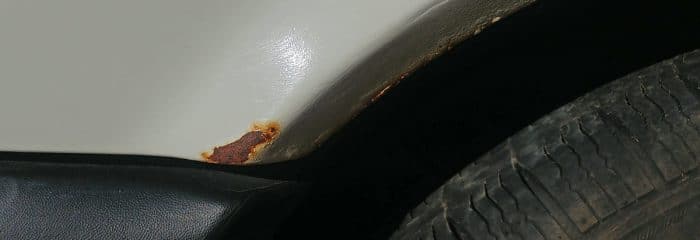
- ☐ Check for rust around wheel arches and door bottoms.
- ☐ Inspect sills and visible structural areas.
- ☐ Look for bubbling paint and previous repairs.
- ☐ Check panel alignment and uneven gaps.
- ☐ Inspect the windscreen for damage.
- ☐ Check door, window and roof seals.
- ☐ Open and close all doors.
- ☐ Inspect visible roof accessories and mounting points.
- ☐ Check the condition of lights and mirrors.
- ☐ Look for signs of accident damage.
- ☐ Check visible areas underneath for leaks or excessive corrosion.
Surface corrosion and cosmetic imperfections may be manageable. Significant structural corrosion is a different matter and should be assessed professionally.
Do not crawl underneath an unsupported vehicle.
If you are buying an older Volkswagen, model-specific corrosion and mechanical issues deserve particular attention. Read our VW T5 buying guide or VW T6 and T6.1 buying guide.
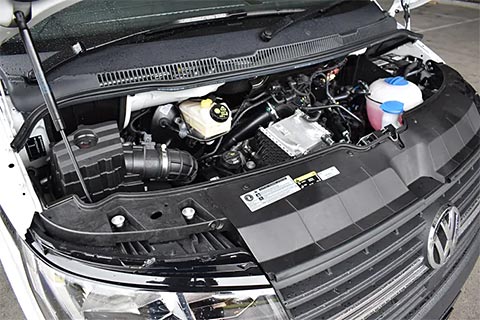
5. Check the engine and mechanical condition
A beautifully converted campervan can still have an expensive mechanical problem. Always assess the base vehicle as carefully as the camping interior.
Ideally, ask to see the engine started from cold. An engine that has already been warmed up may make some starting problems less obvious.
Mechanical inspection checklist
- ☐ Check whether the engine starts readily.
- ☐ Listen for unusual knocking, rattling or excessive vibration.
- ☐ Check for persistent dashboard warning lights.
- ☐ Look for unusual or persistent exhaust smoke.
- ☐ Inspect accessible areas for oil or coolant leaks.
- ☐ Check service history against the manufacturer’s maintenance schedule.
- ☐ Ask about timing belt, timing chain and water pump maintenance, as applicable.
- ☐ Ask about gearbox servicing requirements and previous repairs.
- ☐ Check for previous overheating or coolant loss.
- ☐ Test the vehicle’s heating and air conditioning.
Only check fluids where it is safe to do so and with the seller’s permission. Never remove a coolant expansion tank cap when the engine is hot.
Do not assume that a recent MOT guarantees the mechanical condition of the campervan. An MOT is not a comprehensive mechanical inspection or service.
Bottom line: If you have limited mechanical knowledge, consider paying for an independent pre-purchase inspection. It could identify problems worth considerably more than the inspection fee.
6. Check tyres, wheels, brakes and suspension
Campervans often carry substantial additional weight compared with an empty commercial van. Tyres, wheels, suspension and brakes need to be suitable for the individual vehicle.
- ☐ Check tyre tread and general condition.
- ☐ Look for cracks, cuts and bulges.
- ☐ Check for uneven tyre wear.
- ☐ Ask about tyre age and replacement history.
- ☐ Check tyre and wheel load ratings are suitable.
- ☐ Inspect wheels for obvious damage.
- ☐ Ask about suspension modifications.
- ☐ Check whether a spare wheel or suitable repair equipment is supplied.
- ☐ Assess braking and steering during the test drive.
Campervans can spend long periods parked between trips. Tyres may deteriorate through age and exposure even when they have plenty of tread remaining.
Check the applicable requirements for your particular vehicle and consult a tyre specialist if you are unsure.
7. Look for damp, condensation and water ingress
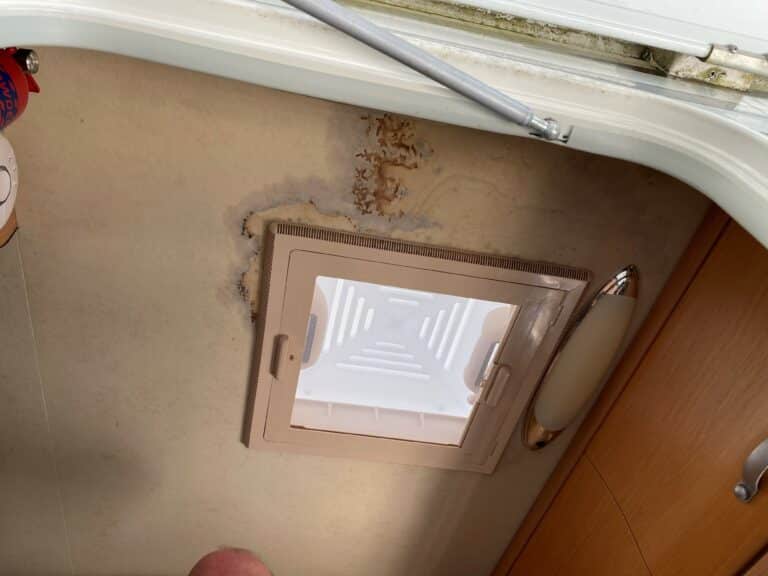
Water ingress can damage furniture, flooring, insulation, electrical equipment and the vehicle body itself.
A campervan may look perfectly presentable while concealing moisture behind furniture or wall panels.
Where to look for damp
- Around windows and roof vents.
- Inside cupboards and overhead lockers.
- Under mattresses and seat cushions.
- Around the pop-top opening.
- Along the edges of the floor.
- Behind accessible furniture.
- Around sinks, pumps and water tanks.
- Near doors and rear openings.
Potential warning signs
- Musty or persistent damp smells.
- Discoloured wall or ceiling panels.
- Swollen furniture or flooring.
- Soft areas in the floor.
- Mould or persistent moisture marks.
- Fresh sealant around previously leaking areas.
- Evidence of repeated repairs.
Condensation is common in campervans and does not necessarily indicate a leaking roof or window. However, persistent moisture problems should be investigated.
A moisture meter may help in suitable materials, but readings can be affected by metal, foil insulation and the construction of the vehicle. Do not rely on a single reading as proof that a campervan is damp-free.
Bottom line: Establish the cause and likely extent of any moisture problem before agreeing a purchase price.
8. Inspect the campervan conversion quality
Whether the campervan was built by a professional conversion company or by its owner, the quality and suitability of the installation matter more than the name attached to it.
Many excellent campervans are self-builds, with owners spending considerable time developing practical layouts and improving their vehicles.
Conversion inspection checklist
- ☐ Check furniture appears securely mounted.
- ☐ Open cupboards and drawers.
- ☐ Check catches and travel restraints.
- ☐ Inspect visible flooring and wall lining.
- ☐ Look for sharp edges and damaged fittings.
- ☐ Check access to electrical equipment and plumbing.
- ☐ Check that ventilation openings are unobstructed.
- ☐ Check that emergency exits remain accessible.
- ☐ Ask who installed the major conversion systems.
- ☐ Ask whether build photographs, receipts or inspection records are available.
Do not confuse attractive furniture with evidence of safe structural or electrical installation.
Equally, do not dismiss a practical, well-built campervan simply because its owner completed the conversion personally.
Our complete UK campervan conversion guide explains how the different parts of a conversion fit together.
9. Check the campervan electrical system
Campervan electrical systems range from a simple leisure battery and a few lights to extensive installations with lithium batteries, solar charging, inverters and mains electrical hook-up.
You do not need to understand every technical detail before buying. However, you should establish what is fitted, how it operates and whether further inspection is necessary.
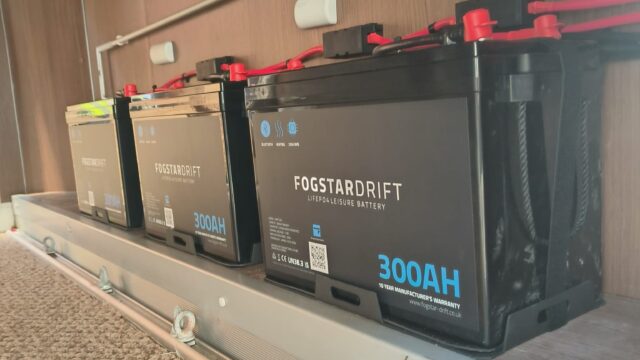
Questions about the electrical system
- Who installed the electrical system?
- What type of leisure battery is fitted?
- How old are the batteries?
- How are they charged while driving?
- Is solar charging fitted?
- Can the batteries be charged from electrical hook-up?
- Is an inverter installed?
- Where are the fuses and isolation switches?
- Are equipment manuals or installation records available?
- Has the system been inspected or tested?
Electrical inspection checklist
- ☐ Ask the seller to demonstrate the lights and sockets.
- ☐ Check the battery monitor, where fitted.
- ☐ Ask for a demonstration of the charging systems.
- ☐ Ask for a demonstration of electrical hook-up, where fitted and safely available.
- ☐ Check accessible areas for damaged cables or signs of overheating.
- ☐ Ask about battery security and electrical protection.
- ☐ Check whether electrical equipment can be accessed for maintenance.
Working lights and sockets do not establish that an electrical installation is safe. Some potentially serious faults are not apparent during normal operation.
Do not remove electrical covers or attempt live electrical testing during a viewing. Where the safety of an installation is uncertain, arrange an assessment by a suitably competent specialist.
Read our campervan electrics guide for more information about leisure batteries, solar panels, charging systems and inverters.
10. Check the gas system, where fitted
Not every campervan uses gas. Some have electric cooking systems or removable camping equipment instead.
If the campervan has a permanent LPG installation, ask the seller to explain its operation and maintenance requirements.
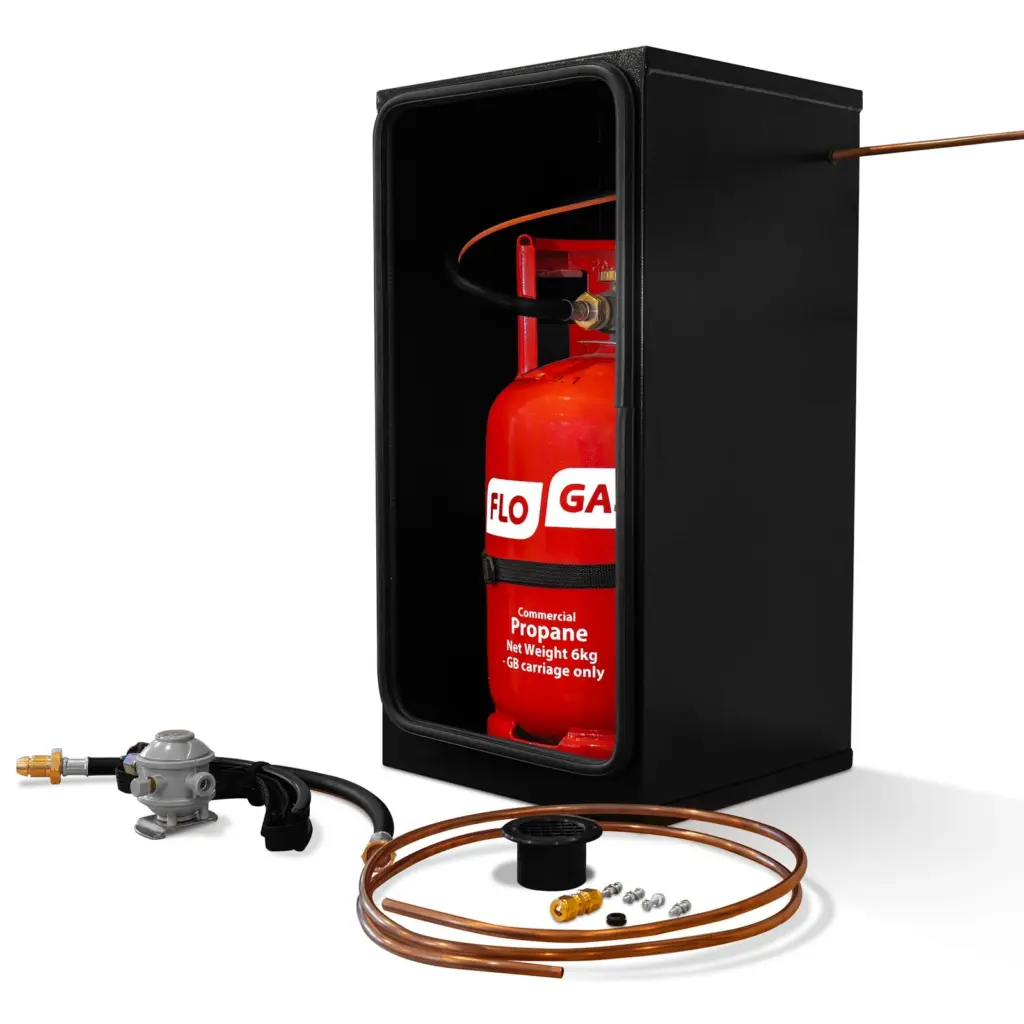
Questions about campervan gas
- What type of gas is used?
- Does it use replaceable cylinders or a refillable system?
- Who installed the system?
- Where is the gas stored?
- Where are the isolation valves?
- How do you safely replace or refill the gas supply?
- When was the system last inspected?
- Are any installation or inspection records available?
Gas inspection checklist
- ☐ Ask the seller to demonstrate the installed gas appliances if safe to do so.
- ☐ Check that cylinders appear securely stored.
- ☐ Check accessible equipment for obvious damage.
- ☐ Ask about the gas locker and ventilation arrangements.
- ☐ Check that suitable carbon monoxide detection is provided.
Do not attempt to dismantle gas equipment or test for leaks yourself during a viewing.
If you smell gas, do not operate electrical switches, light appliances or continue testing equipment. Leave the vehicle and arrange appropriate specialist assistance.
If installation quality or safety cannot be established, arrange an inspection by a competent engineer with appropriate LPG leisure vehicle expertise before purchasing.
11. Check the heating system
Campervan heating is particularly useful for camping throughout the British autumn and winter.
Depending on the conversion, heating may be provided by diesel, LPG or suitable electrical equipment.
- ☐ Establish which type of heater is fitted.
- ☐ Ask who installed it.
- ☐ Ask the seller to demonstrate the controls.
- ☐ Check whether it produces warm air normally.
- ☐ Ask about servicing and previous faults.
- ☐ Check that operating instructions are available.
- ☐ Ask about fuel supply and electrical requirements.
- ☐ Ask about the heater’s shutdown procedure.
A heater producing warm air does not prove that its exhaust, fuel supply or combustion system has been installed safely.
Where you have concerns, arrange an independent inspection.
Our diesel night heater guide explains more about these popular heating systems.
12. Check water systems, sinks, toilets and showers
Some campervans have little more than a removable water container. Others have fixed tanks, pumps, hot-water systems, showers and toilets.
Only assess equipment that is actually fitted to the campervan.
- ☐ Ask how to fill the fresh-water supply.
- ☐ Ask how to drain and clean the water system.
- ☐ Test taps and pumps where water is available.
- ☐ Look for visible leaks around accessible connections.
- ☐ Ask how waste water is collected and emptied.
- ☐ Ask the seller to demonstrate the hot-water system.
- ☐ Check the shower, where fitted.
- ☐ Ask how the toilet operates.
- ☐ Ask how the toilet is emptied and cleaned.
- ☐ Ask how the system is protected during freezing weather.
If the vehicle has been winterised and the water system drained, the seller may not be able to demonstrate every function immediately.
Record anything that has not been tested rather than assuming it works or treating it as a confirmed fault.
13. Check the kitchen, fridge and cooking equipment
Ask the seller to demonstrate the kitchen equipment and explain its power or fuel requirements.
- ☐ Check the cooker and its controls.
- ☐ Establish which energy sources the fridge uses.
- ☐ Ask how the fridge operates while driving and camping.
- ☐ Check the fridge door and seals.
- ☐ Inspect cooking surfaces and surrounding materials.
- ☐ Check storage catches and restraints.
- ☐ Ask whether appliance instructions are available.
A fridge may take time to reach its operating temperature. Switching it on briefly is not a complete test of its cooling performance.
Read our campervan fridge guide to understand the different refrigeration systems.
14. Check the pop-top roof and awning
A pop-top roof can be one of the most useful features of a compact campervan. It can also be expensive to repair or replace.
Ask the seller to demonstrate the complete opening and closing procedure.
- ☐ Check the canvas for tears, mould and damage.
- ☐ Inspect visible seams and seals.
- ☐ Check the lifting mechanism operates smoothly.
- ☐ Ask about roof bed weight limits.
- ☐ Check roof locking and securing arrangements.
- ☐ Ask about previous repairs or water ingress.
- ☐ Check that the canvas folds away correctly.
- ☐ Ask for a demonstration of any fitted awning.
Only operate roofs and awnings in suitable conditions and according to their instructions.
Before driving, ensure the roof and awning are fully closed and secured.
Read our VW Transporter pop-top guide.

15. Check beds, passenger seats and seat belts
One of the most important considerations when buying a family campervan is understanding the difference between seats used while camping and seats intended for travelling.
A folding bed or rear bench is not automatically suitable for carrying passengers on the road.
- ☐ Establish how many suitable travelling seats are fitted.
- ☐ Check seat belts for visible damage.
- ☐ Ask who installed additional passenger seats.
- ☐ Request supporting installation evidence where available.
- ☐ Check compatibility with required child restraints.
- ☐ Ask the seller to demonstrate the bed arrangements.
- ☐ Check how folding seats return to their travelling positions.
- ☐ Check access to exits when beds are deployed.
Passenger seat mountings and seat belt anchorages are safety-critical. A visual inspection alone may not establish whether they are suitable.
Arrange a specialist assessment where you cannot establish the safety or suitability of additional travelling seats.
Our campervan beds guide explains the different sleeping arrangements available.
16. Check campervan weight and payload
A campervan can have plenty of physical storage space without having enough legal carrying capacity to fill it.
Furniture, batteries, water, roof accessories and other conversion equipment all contribute to the vehicle’s weight.
Passengers, luggage, bikes and camping equipment add further weight when travelling.
Questions to ask about weight
- What is the vehicle’s maximum authorised mass?
- What are its individual axle weight limits?
- Has the completed campervan been weighed?
- Is a weighbridge ticket available?
- What was included when it was weighed?
- How much carrying capacity remains for passengers and equipment?
If the weight is uncertain, consider arranging for the campervan to be weighed before purchasing.
Check that your driving licence covers the vehicle and that the remaining payload suits your intended use.
Useful Dubbed Out guides include:
- Campervan payload explained
- VW Transporter weight classifications explained
- Campervan driving licence requirements
See also GOV.UK vehicle weights explained.
17. Does the campervan need to be registered as a motor caravan?
Do not automatically reject a converted campervan because the V5C still describes it as a panel van or another body type.
The DVLA’s recorded body description is not the same as a comprehensive assessment of conversion safety or the vehicle’s legal classification for every purpose.
A vehicle may be suitable for use as a motor caravan without the DVLA changing its recorded body description, provided the relevant requirements are satisfied.
Check whether the vehicle’s registration details, alterations and intended use are appropriate. Discuss any uncertainties with your insurer and the relevant authorities.
Read our DVLA motor caravan guide and the official GOV.UK motor caravan conversion guidance.
18. Confirm your own campervan insurance
The seller’s existing insurance arrangements do not guarantee that you will receive the same cover.
Before purchasing, confirm that your chosen insurer will cover the campervan, including its existing conversion and any modifications or upgrades you intend to make.
Specialist campervan insurers may accommodate ongoing self-build projects and continuous upgrades, depending on their policy terms.
Discuss your plans directly with your insurer or broker.
Things to confirm
- Whether the existing conversion is acceptable.
- Whether self-built campervans are covered.
- How future modifications should be declared.
- Whether installed equipment and accessories are covered.
- How the campervan will be valued.
- Whether any inspection records are required.
- Whether particular security equipment is required.
- Whether your intended use and destinations are covered.
Read our UK campervan insurance guide.
19. Ask the seller to demonstrate everything
This is one of the most useful parts of a campervan viewing, especially if you have never owned one before.
Do not be embarrassed to ask basic questions. Every campervan is different, and even experienced owners need time to understand an unfamiliar conversion.
Where equipment is fitted and can be operated safely, ask the seller to show you the following.
| Equipment | What to ask the seller to demonstrate |
|---|---|
| Leisure electrics | Switching the system on and off, checking battery levels and locating isolation switches. |
| Battery charging | How the leisure batteries charge while driving, on solar and through mains hook-up. |
| Electrical hook-up | How to connect and disconnect the supply safely. |
| Inverter | How to operate it and which appliances it can support. |
| Heating | Starting the heater, adjusting the temperature and shutting it down correctly. |
| Gas | The type of gas used, isolation valves and the correct replacement or refilling procedure. |
| Cooker | Normal operation and shutdown. |
| Fridge | Operating modes, temperature controls and power requirements. |
| Fresh water | How to fill, drain and clean the water supply. |
| Waste water | How and where to empty it appropriately. |
| Toilet | Operation, emptying and cleaning. |
| Hot water and shower | Normal operation and relevant safety controls. |
| Pop-top | Raising, lowering and securing the roof. |
| Beds | Setting up sleeping arrangements and restoring travelling seats. |
| Awning | Opening, securing and packing it away. |
| Winter preparation | How the vehicle and its equipment are prepared for colder weather or storage. |
With the seller’s permission, record short videos of unfamiliar equipment being demonstrated. These can be extremely useful when you arrive at your first campsite and discover you cannot remember which switch does what.
Ask for the original equipment manuals where available.
Bottom line: Understanding how the campervan works is part of buying it. A practical handover is valuable, but it does not replace a safety inspection.
20. Take the campervan for a test drive
Never underestimate the importance of a test drive. You need to establish whether the vehicle drives properly and whether you feel comfortable using it.
Confirm that the appropriate insurance is in place before driving.
During the test drive
- ☐ Check the clutch operation, where applicable.
- ☐ Check that gears engage correctly.
- ☐ Listen for unusual gearbox noises.
- ☐ Check steering response.
- ☐ Assess braking during normal, safe driving.
- ☐ Listen for suspension noises.
- ☐ Check for unusual vibration.
- ☐ Monitor dashboard warning lights and engine temperature.
- ☐ Listen for excessive movement from conversion furniture.
- ☐ Assess visibility and driving position.
- ☐ Check parking and manoeuvring suitability.
After the drive, look for new visible leaks or unusual smells without touching hot components.
If the seller will not permit a test drive, ask why. Where a suitable test drive cannot be arranged, consider an independent inspection before making a decision.
21. Check that the campervan suits your lifestyle
It is easy to fall in love with an attractive campervan interior. However, the best campervan is the one that works for the way you intend to use it.
Imagine a typical camping weekend.
- Can everyone travel safely?
- Can everyone sleep comfortably?
- Is there enough room for your belongings?
- Where will wet clothing and muddy shoes go?
- Can you prepare food comfortably?
- Is there sufficient room for your dog?
- Can you access essential equipment with the bed set up?
- Can you park the vehicle at home?
- Will it fit under your usual height restrictions?
- Is the layout suitable for longer trips?
- Can you comfortably afford its running costs?
For help deciding which size and style of vehicle suits you, read our campervan versus motorhome guide.
22. Buying privately versus buying from a dealer
Buying from a trader and buying privately offer different levels of legal protection.
| Buying from a trader | Buying privately |
|---|---|
| Consumer Rights Act protections generally apply. | Consumer Rights Act protections concerning satisfactory quality generally do not apply in the same way. |
| The vehicle must be of satisfactory quality, fit for purpose and as described, taking relevant circumstances into account. | The seller must have the right to sell the vehicle and must not misrepresent it. |
| A warranty may be included or available. | There is usually no dealer-style warranty. |
| Statutory remedies may be available if the vehicle does not conform to the contract. | Resolving problems discovered after purchase can be more difficult. |
For qualifying purchases from a trader, the Consumer Rights Act 2015 generally provides a short-term right to reject goods that do not conform to the contract within 30 days, subject to applicable conditions.
This is not a general right to return a campervan simply because you change your mind.
Age, mileage, price, disclosed defects and reasonable expectations can all be relevant when assessing the condition of a used vehicle.
Both private sellers and traders are subject to applicable laws concerning the sale of unroadworthy vehicles.
Be cautious if somebody appears to be operating as a trader while claiming to be a private seller.
See Citizens Advice guidance on buying a used vehicle for further information. Specific procedures and advice services may differ across the UK.
23. Calculate the real cost of buying the campervan
The asking price is only part of the cost of buying a used campervan.
Consider immediate repairs, maintenance, insurance and any essential equipment that needs replacing.
Illustrative purchase cost calculation
| Item | Example cost |
|---|---|
| Agreed purchase price | £25,000 |
| Estimated mechanical work | £800 |
| Replacement tyres | £500 |
| Electrical or habitation inspection | £250 |
| Initial equipment and minor repairs | £450 |
| Estimated initial expenditure | £27,000 |
These figures are illustrative only and are not current repair quotations or recommended prices. Obtain actual estimates for the individual campervan.
Our downloadable checklist includes space to record potential repair costs and calculate your expected purchase expenditure.
Read our guide to buying your first campervan for more information about ownership costs.
24. When should you walk away from a campervan?
Not every fault is a reason to abandon a purchase. However, some problems deserve particular caution.
- Unresolved discrepancies with the vehicle’s identity or ownership.
- Outstanding finance without a satisfactory settlement arrangement.
- Evidence of significant structural corrosion.
- Serious mechanical faults without a clear repair assessment.
- Extensive unexplained water damage.
- Suspected unsafe electrical or gas installations.
- Uncertain passenger seat or seat belt mounting safety.
- Insufficient legal payload for your intended use.
- Inability to obtain appropriate insurance.
- Unreasonable pressure to pay immediately.
- Refusal to allow reasonable independent inspection.
Some of these issues may be resolved through investigation, repair or a revised purchase agreement. Others may make the campervan unsuitable for your needs.
Do not let excitement about a particular vehicle prevent you from making a sensible decision.
There will be other campervans.
25. A note about self-built campervans
Many excellent campervans have been converted by their owners rather than professional conversion companies.
The absence of installation certificates or original conversion invoices does not automatically mean a campervan is unsafe or poorly built.
Equally, the presence of professional conversion paperwork does not guarantee that every installation remains safe or suitable today.
Ask about the workmanship, materials and equipment used. Request any available photographs, receipts or inspection records.
Where you are unsure about the safety of electrical systems, gas installations, structural alterations or passenger seating, arrange an independent assessment by a suitably competent specialist before purchasing.
This checklist is intended to help you make an informed buying decision and is not a substitute for a professional vehicle or habitation inspection.
26. Completing the purchase
Once you are satisfied with the campervan, agree the purchase arrangements clearly.
- Confirm the agreed price in writing.
- Record any agreed repairs or work to be completed.
- Confirm which accessories are included.
- Obtain an appropriate receipt or sales invoice.
- Collect keys, manuals and available documentation.
- Ensure the registered keeper details are updated appropriately.
- Arrange your own insurance before driving.
- Tax the vehicle before using it on public roads, where required.
- Confirm its MOT status and roadworthiness.
- Complete a final equipment handover.
Vehicle tax does not transfer to the new keeper when a vehicle is sold.
Once you have purchased your campervan, use our complete campervan maintenance and safety checklist to prepare for your first trip.
Frequently asked questions about buying a used campervan
What is the most important thing to check when buying a used campervan?
Start with the vehicle’s identity, history, mechanical condition and structural integrity. Then assess the conversion, passenger seating, electrical and gas systems, payload and suitability for your needs.
Should I buy a self-built campervan?
A well-executed self-build can be an excellent purchase. Assess the quality and suitability of the work rather than automatically favouring professional conversions. Arrange independent inspections where safety is uncertain.
Does a self-built campervan need installation certificates?
There is no single universal certificate requirement covering every private campervan conversion. Requirements depend on the installation, alterations, applicable regulations and intended use. Insurers may also have their own conditions.
Should I pay for a pre-purchase campervan inspection?
An independent inspection is particularly useful if you have limited mechanical or technical knowledge. Establish whether the inspection covers the base vehicle, habitation systems or both.
Does an MOT cover the campervan conversion?
An MOT assesses relevant vehicle roadworthiness requirements. It is not a comprehensive assessment of the campervan’s gas, habitation electrical, water or other camping systems.
How can I tell if a campervan has damp?
Look for persistent musty smells, staining, mould, swollen furniture, soft flooring and signs of water ingress around windows and roof openings. Arrange a specialist assessment if you suspect significant hidden moisture damage.
Should I buy a campervan without a service history?
Missing service history increases uncertainty about previous maintenance. It does not automatically make the vehicle unsuitable, but you should consider an independent inspection and budget for maintenance that cannot be verified.
Can I buy a campervan that is still registered as a panel van?
Potentially, yes. The recorded body description is not the only consideration. Check the vehicle’s conversion, applicable legal requirements, registration obligations and insurance suitability.
How do I know if a campervan is overweight?
Check the vehicle’s permitted total and axle weights and compare them with actual weighbridge measurements. Allow for passengers, water, luggage and equipment that will be carried.
Should the seller demonstrate the campervan equipment?
Ideally, yes. A practical demonstration helps you understand the heating, electrical system, water supply, gas equipment, beds and other facilities. Record anything that cannot be demonstrated or tested.
Can I drive a used campervan home immediately after buying it?
Only if you have the appropriate driving licence, insurance, vehicle tax where required and a valid MOT where required. The vehicle must also be roadworthy.
Is it better to buy a campervan privately or from a dealer?
Both can be suitable. Buying from a trader generally provides stronger consumer protections, while private purchases may offer different prices and opportunities. Assess the individual vehicle and understand your rights.
Is there a free printable campervan buying checklist?
Yes. Dubbed Out provides a free five-page used campervan buying checklist covering vehicle history, mechanical condition, conversion quality, seller questions, equipment demonstrations and purchase costs.
Bottom line: take your time when buying a campervan
Buying a campervan should be the beginning of an exciting new chapter, not the beginning of a long list of unexpected repair bills.
Take your time, ask questions and do not be embarrassed about unfamiliar equipment.
Many campervan owners are happy to explain their conversions and share the experience they have gained over years of camping.
Remember that the perfect campervan does not necessarily exist. Even experienced owners regularly discover something they would like to change or improve.
What matters is finding a safe, suitable vehicle that you understand, can afford and will enjoy using.
Take the Dubbed Out Buying Checklist With You
Print our free five-page checklist before your next campervan viewing. Record your findings, ask the right questions and compare potential purchases.
Download Your Free PDF Checklist
Created by Dubbed Out VW Community. Free to download, print and share.
Join the Dubbed Out VW Community
Thinking about buying your first campervan? Unsure which Volkswagen to choose? Or perhaps you have found a campervan and would like to hear from owners of similar vehicles.
Join the Dubbed Out VW Community on Facebook to exchange experiences, ask questions and share your adventures.
We welcome owners of all makes and models of campervan, from classic Volkswagens to modern touring vehicles.
Explore more practical guides, buying advice and camping inspiration at dubbedout.co.uk.
Get early access to Dubbed Out Festival tickets
Dubbed Out Festival brings campervan owners, Volkswagen enthusiasts and families together for a weekend of camping, live entertainment and great company.
It is a fantastic opportunity to meet other owners, explore different campervan layouts and discover ideas for your own vehicle.
Our next festival takes place at the Royal Cheshire Showground, Knutsford, from 29 July to 1 August 2027. Tickets are scheduled to go on sale on 31 January 2027 through our authorised ticket provider, Ticket Tent.
Register for early access to festival tickets and the latest announcements at dubbedoutfestival.co.uk.
Useful official resources
- GOV.UK: Buying a vehicle
- GOV.UK: Check MOT history
- GOV.UK: Get vehicle information from DVLA
- GOV.UK: Check vehicle safety recalls
- GOV.UK: Vehicle weights explained
- GOV.UK: Check that your vehicle is safe to drive
- Citizens Advice: Buying a used vehicle
- Consumer Rights Act 2015
Published November 2026. This guide and its accompanying checklist provide general buying guidance. They are not a guarantee of vehicle condition, conversion safety or legal compliance. Obtain appropriate independent professional advice and inspections where necessary.