

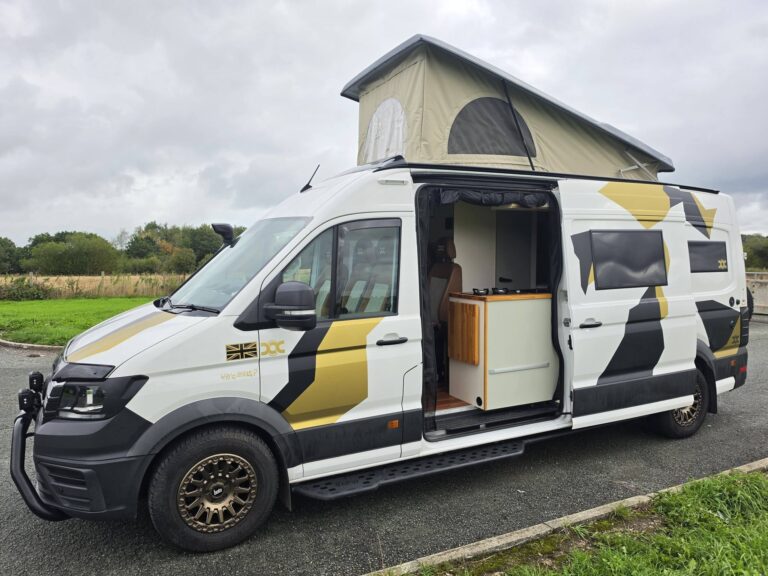
Ask a room full of campervan owners what their payload is and you’ll get a lot of shrugs. Ask what they’ve got on the roof, the back and under the bed, and you’ll get a very long list. The gap between those two answers is where overloaded vans come from.
This guide is an owner talking to owners. It explains the numbers on your van’s plate in plain English, shows you what counts towards your weight, covers the big panel-van conversions that so many of us are building, and points you to public weighbridges across the UK so you can find out what your van really weighs. If you’re planning to bring a loaded van to Dubbed Out next summer (29 July to 1 August 2027, at the Royal Cheshire Showground), it’s a good job to tick off well beforehand.
A quick note: this is general guidance, not legal or engineering advice. Your van’s own plate and handbook always win. If anything here doesn’t match them, trust the plate and ask your manufacturer or a specialist.

The three numbers that matter: MTPLM, mass in running order and payload
MTPLM (also called MAM or gross vehicle weight)
This is the most your van is allowed to weigh when it is fully loaded and on the road. You’ll see it called MTPLM (maximum technically permissible laden mass), MAM (maximum authorised mass), GVW (gross vehicle weight) or “permissible maximum weight”. They all describe the same ceiling. GOV.UK explains that MAM is the weight of the vehicle plus the maximum load it can carry safely on the road, and that it is listed in the owner’s manual and normally shown on a plate or sticker fitted to the vehicle.
Mass in running order (MiRO)
This is the weight of the van as it is built and ready to drive, with a driver on board, before you load your own things. It is not the same as the “unladen” or “kerb” weight in a brochure, so don’t mix them up.
The type-approval rules define mas
s in running order as the vehicle with its fuel tank filled to at least 90% of capacity, including the driver (rated at 75kg), fuel and other liquids, with the standard equipment fitted, plus the bodywork, cabin, spare wheel and tools where fitted. The Camping and Caravanning Club adds that motorhome makers vary in what they include. Traditionally it is 75kg for the driver, a 90% full fuel tank and a gas allowance, and the water allowance has ranged from a 90% full tank on older vans to an empty tank or one filled to 20% on newer ones. The gas allowance can also be limited.
What mass in running order generally does not include is optional equipment, extras added later, your passengers beyond the driver, and everything you pack. Because makers differ, check what your own manufacturer counts. Your handbook or dealer can tell you.
Payload
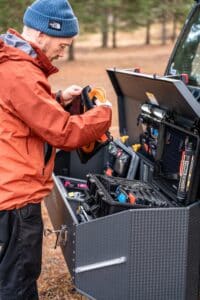
Payload is the difference between the two: payload = MTPLM minus mass in running order. It is everything you can add to the van before you hit the limit. Practical Motorhome gives a neat example: a Renault Trafic conversion with a plated weight of 2,960kg and a running order weight of 2,600kg has a payload of 360kg, and that is before you subtract the people on board.
One warning: if your van has had extras fitted since it was built, by a dealer, a converter or a previous owner, those come out of the payload too.
Where to find your figures
- The vehicle plate. Every motorhome and campervan carries a plate or sticker with its maximum weight and the maximum for the front and rear axles. The Camping and Caravanning Club says it is usually under the bonnet. On some vans you’ll find it on a door pillar or sill, so look around. If your van has been converted, there may be a second plate from the converter, so check which one applies to your vehicle.
- The handbook. GOV.UK says the maximum authorised mass is listed in the owner’s manual.
- The V5C (logbook). Your V5C may show weight figures for the vehicle too. Compare them with the plate. If they disagree, ask the manufacturer or a specialist before you rely on either.
Write the figures down somewhere you can find them again, and keep a photo of the plate on your phone.
What counts towards your weight
The limit includes everything in or on the van while it is on the road. GOV.UK’s guidance on vans says the weight limit includes the van, the driver and passengers, the fuel and the load. For a campervan, the load list gets long quickly.
Printable checklist: what counts toward your weight
Tick these off
and write a rough weight next to each, then check the total against your payload.
- ☐ Passengers, including children, beyond the 75kg driver already counted in mass in running order
- ☐ Fuel, if your maker counts less than a full tank in running order
- ☐ Fresh water (one litre of water weighs one kilogram, so 40 litres is 40kg)
- ☐ Gas cylinders (Out and About lists around 17kg for a full 6kg cylinder and around 35kg for a full 13kg cylinder)
- ☐ Food, drinks, crockery, cutlery and cooking kit
- ☐ Bedding, towels, clothes and shoes
- ☐ Camp chairs, tables, windbreaks, groundsheets and the barbecue
- ☐ Awning (Out and About lists driveaway awnings at around 10 to 30kg and wind-out awnings at around 25 to 60kg)
- ☐ Bikes and the bike rack, including e-bikes (Out and About lists around 15kg for a pedal cycle, 25kg for an electric bike and 10kg for a rack)
- ☐ Roof box, roof rack and anything on top
- ☐ Dog, dog crate, bed, bowls and food
- ☐ Tools, spare wheel, jack and recovery kit if not already counted
- ☐ Leisure batteries and electrics added since the van was built (Out and About lists around 30kg for a 100Ah lead-acid battery and around 15kg for a 100Ah lithium one)
- ☐ Accessories added by you or a previous owner: towbar, solar panels, air conditioning, extra seating
- ☐ Everything in the garage, boot or cupboard “just in case”
The item weights above are typical figures from Out and About’s guide, so treat them as a starting point. Your own kit may be heavier or lighter, which is exactly why a weighbridge visit beats guessing.
Axle limits: the one people forget
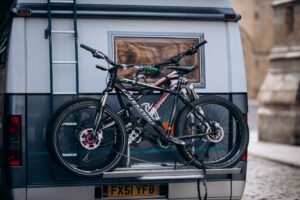
Your plate doesn’t only show the overall limit. It also shows a maximum for the front axle and a maximum for the rear axle. Out and About points out that the axle limits often add up to more than the overall weight limit, so you can be under the van’s total and still be over on one axle. Practical Motorhome says it’s very often the rear axle, though sometimes the front.
The fix is often simple: move heavy items to a different spot. The Camping and Caravanning Club warns that heavy loads at the extreme rear, including bike racks and rear boxes, are particularly critical, and that e-bikes are generally much heavier than standard bikes. GOV.UK’s van guidance also says to load evenly and put the heaviest items at the bottom.
Big panel-van conversions: Crafters, Sprinters, Boxers, Ducatos and Transits
Lots of us are tempted by a large panel van. There’s room for a proper bed, a kitchen, a shower and the dog. But a heavy conversion is exactly where payload quietly disappears, so this section is worth a slow read.
Start with what the maker plates it at
Large panel vans are sold at different plated weights. Volkswagen’s UK Crafter panel van brochure lists CR30 versions at 3,000kg gross vehicle weight, CR35 at 3,500kg and CR50 at 5,000kg. The brochure also shows an empty van’s payload, and for the medium-wheelbase CR35 versions the figures run from roughly 1,000kg to 1,230kg depending on engine, gearbox and trim. VW’s footnotes explain that unladen weight includes about 90% fuel and a 75kg driver, and that payload can be affected by trim, factory options and fitted accessories. These are bare-van figures from one brochure, so check VW’s current information and, above all, your own plate.
Other large panel vans (Mercedes-Benz Sprinter, Peugeot or Citroen Boxer, Fiat Ducato, Ford Transit and others) are also sold at a range of plated weights, and the right figure depends on the exact model and year. We haven’t listed those here. Check your own plate.
How the conversion eats the payload
That bare-van payload is your starting pot, and a conversion spends it before you’ve packed a single sock. Insulation, a floor, a bed, kitchen units, a water tank and pump, a heater, leisure batteries, a toilet or shower, a roof rack, roof vent, solar panels, an awning and a bike rack all add weight. Practical Motorhome gives one real example: a Ducato high roof alone weighs around 100kg. Out and About lists a wind-out awning at 25 to 60kg and a lead-acid leisure battery at around 30kg.
Add a full water tank and a couple of people and a heavy build can be left with very little payload, sometimes none. The honest way to know is to weigh it, not to add up a spreadsheet. SvTech, a specialist in plating and uprating, notes that a manufacturer’s brochure kerb weight can have a 5% margin of error, and advises owners to have an up-to-date weight ticket showing the van is well within its official gross weight.
Can it be re-plated?
Sometimes. SvTech explains that uprating (raising the plated weight to carry more) can be as simple as a converter’s plate and a letter of declaration on some vehicles, while others need physical changes to the vehicle. Practical Motorhome adds that raising the maximum weight on paper doesn’t alter the individual axle limits, so you still need to stay within each axle’s limit. If you’re thinking about it, talk to the manufacturer or a specialist before you buy a conversion that is already tight on payload.
GOV.UK says that if you change the weight of a large vehicle such as a campervan, you must update your V5C and provide either a plating certificate or a design weight certificate.
Which licence do you need?
The licence rules turn on the van’s plated weight (MAM), not what it weighs on the day:
- Passed your car test on or after 1 January 1997: category B lets you drive vehicles with up to 8 passenger seats and a MAM of up to 3,500kg. GOV.UK says the higher 4,250kg figure applies to electric or hydrogen vehicles only, meaning zero emission vehicles. A diesel panel van plated above 3,500kg is outside category B.
- Vehicles between 3,500kg and 7,500kg MAM: GOV.UK says you need category C1 to drive a motorhome with a MAM between 3.5 and 7.5 tonnes.
- Passed your car test before 1 January 1997: GOV.UK’s licence guidance says you may have additional C1 entitlement, but it is retained only until your licence expires or is revoked for medical reasons, and higher Group 2 medical standards apply on renewal. The Camping and Caravanning Club adds that C1 entitlement from a pre-1997 licence is lost at 70 unless you reapply with the D2 and D4 forms. Check your own licence on GOV.UK.
Some owners choose to “down-plate” a heavier motorhome to 3,500kg so they can drive it on a category B licence. GOV.UK describes down-plating as a lower weight being shown on the plate or sticker. SvTech says downrating a motorhome is dealt with by the DVLA and more often than not needs no physical changes. Ask a specialist whether it suits your van.
Telling the DVLA
GOV.UK says you do not have to change your V5C body type to use a converted van as a motorhome, and that a van can still be used as a motorhome as long as you are satisfied it meets the required internal features. You must, though, tell DVLA and update your V5C if you change the weight of a large vehicle such as a campervan, or the seating capacity. GOV.UK also lists a change of body type, for example converting a van to a campervan or “motor caravan”, as something you must tell DVLA about, and DVLA gives the body type description based on the vehicle’s external appearance. DVLA’s motor caravan guidance lists the permanent external features it looks for (such as two or more side windows, a separate door to the living area, and a high-top or pop-top roof) and requires photographs and a completed checklist.
GOV.UK also says it is the keeper’s responsibility to make sure alterations don’t compromise safety, and that if you sell, it is up to you to show the conversion work was done safely.
Practical steps for a converted van
- Note the plated weight and axle limits from your plate, and photograph it.
- Weigh the finished van empty, with no touring kit or passengers on board. Out and About describes this as your starting figure, and recommends an almost empty fuel tank and no water for the reading. Make a note of how much fuel and water were in it.
- Subtract that from your plated weight. That is your real payload, before people.
- Weigh it again loaded, as you’d go on a big trip, with the passengers who normally travel.
- Keep both tickets with the V5C and write the figures in the glovebox.
- If the numbers are tight, talk to the manufacturer or a specialist about options before you load up.
Why it matters: fines, safety and insurance
Fines
GOV.UK’s van guidance says you can be fined up to £300 or get a court summons if your van exceeds its maximum permitted axle weight. DVSA’s guidance on roadside fines says excess weight fixed penalties are graduated: £100 for less than 10% over, £200 for 10% up to but not including 15% over, and £300 for 15% and over. Serious overloads can lead to a court summons instead. A roadside check can also end in a prohibition, which stops the vehicle moving until the problem is sorted. Those are the figures at the time of writing, so check GOV.UK for the latest.
Safety
The Camping and Caravanning Club says overloading has the potential to cause failure of tyres and suspension and to affect braking and handling. Out and About adds longer braking distances and reduced manoeuvrability. A van that feels fine on a flat lane may feel very different on a wet hill with a crosswind, so it’s not worth finding out.
Insurance
The Camping and Caravanning Club warns that an overloaded vehicle may be seen by your insurer as a reason not to pay out on claims and could remove your third-party cover. Read your own policy wording, and if in doubt, ask your insurer.
How to weigh your van properly
- Load it as you would for a big trip. The Camping and Caravanning Club suggests going to a public weighbridge loaded as you would expect for a major trip, and with the normal load of passengers.
- Weigh the whole van first. That gives you the total to compare with your plated weight.
- Weigh each axle if you can. The Club’s method is two weighings: one with both axles on the platform, and another with just one axle on it. From those readings you can work out the front and rear axle loads and check them against the plate. Some weighbridges can’t do this (see the list below), so ask when you ring.
- Keep the ticket. It’s proof of what you did if you are ever stopped, and it’s the best record for your payload notes.
- Fix any problems. Clear out what you don’t need, move heavy things lower and away from the extreme rear. Think carefully about water: Out and About notes that one litre weighs one kilogram and that many manufacturers recommend not travelling with any, and the Camping and Caravanning Club says most vehicles aren’t designed to travel with full water tanks. Tyre pressures may also need to change for your loaded weight, so check your handbook or the tyre maker.
Public weighbridges you can try
Most weighbridges are run by private businesses and councils, so the details change. GOV.UK’s guidance is to contact the operator before you go to check the cost, how to get there and the opening hours, and to tell them if your vehicle is very large. Please ring ahead every time, because hours and rules change. The prices below are quoted from the operators’ own pages, so check current prices.
We haven’t contacted any of these operators and we’re not affiliated with them. This is a starting selection, not a complete list. GOV.UK has a Find a weighbridge page to help you look near you.
North West and Cheshire (near Knutsford)
- Brit European, Middlewich, Cheshire. Operator page. A public dynamic axle weighbridge for vans and trucks, booked online by time slot, and it gives individual axle weights as well as the gross weight. The page quotes £17.99 including VAT for vehicles with three axles or fewer (check current price), and Cheshire East Council lists its hours as Monday to Friday 8.30am to 4.30pm. It says vehicles with tandem or closely spaced axles may not be suitable, so tell them what you’re bringing.
- Stuart Shentons, Henbury, near Macclesfield, Cheshire. Cheshire East Council listing. Listed by Cheshire East Trading Standards as a public weighbridge available to businesses or the general public. The council gives hours of Monday to Friday 7.30am to 5pm and Saturday 8am to 12 noon, and a phone number of 01625 861315.
- T G Group, Tattenhall, Cheshire. Cheshire West and Chester Council listing. The council lists a 15m by 3m plate, open Monday to Friday 7.30am to 5pm and Saturday 7.30am to 12 noon, closed Sundays and bank holidays, phone 01829 770421.
- Massams Supplies, Halsall, Lancashire. Operator page. The page lists motorhomes among the vehicles it can weigh and says no appointment is needed, just call ahead or visit during opening hours. Open Monday to Friday 7.30am to 5pm and Saturday 7.30am to 12 noon, closed Sundays.
Yorkshire
- Poskitt Carrots, Kellington, near Goole. Operator page. The page lists cars, caravans and motorhomes, says no appointment is needed, and says it takes cash, card and contactless. Open 7.30am to 4pm Monday to Friday and 7.30am to 3pm on Saturday and Sunday.
- Bradford Council, Bradford and Keighley. Council page. Two council weighbridges (Bowling Back Lane in Bradford and Royd Ings in Keighley) that the page says the public can use for cars, caravans and motor homes. The page asks you to phone before setting off, says they are open Monday to Friday only, and says card payment only. It also says they weigh gross and tare weights only and cannot weigh individual axles. The page quotes £10.50 including VAT (check current price).
Midlands, East and South
- Hadleigh Salvage and Recycling, Southend-on-Sea area. Operator page. The page says its weighbridge is open to the public, including to check the weight of your caravan before setting off on holiday. It doesn’t list hours or prices, so ring first.
- Nicholas Rowell Haulage, Torr Quarry, near Kingsbridge, Devon. Operator page. The page mentions vans, trailers, caravans and trucks. It describes a 40 tonne weighbridge with an 8m by 3m plate. Open Monday to Friday 7.30am to 5.30pm and Saturday 9am to 12 noon.
Wales
- Wrexham County Borough, Llay and Wrexham Industrial Estate. Council page. The council lists two public weighbridges: 2 Agriculture at Llay Industrial Estate (6am to 8pm Monday to Friday, 6am to 12 noon Saturday) and Entrec at Wrexham Industrial Estate (8am to 4.30pm Monday to Friday, 8am to 11am Saturday). Phone numbers are on the page.
Scotland
- Scottish Borders, including Duns, Coldstream, Earlston and Kelso. Council page. The council describes a public weighbridge as one that anyone can use for a small charge and lists several, with addresses. Contact the operator to confirm price and opening hours before you visit.
- Fife, including Ladybank, Thornton, Glenrothes, Kirkcaldy and Rosyth. Council page. The council lists weighbridges “available for public use” with phone numbers, opening hours and plate sizes, and says to contact the operator to confirm price and hours before visiting. One site notes clean vehicles only.
Northern Ireland
- DVA self-weigh sites: Belfast (Garmoyle Street), Larne, Lisburn (Sprucefield), Loughbrickland, Nutts Corner and Toome. nidirect page. The Driver and Vehicle Agency says these six dynamic axle weighbridges offer self-weigh facilities at no charge so you can voluntarily check your vehicle’s weights at any time. You drive very slowly over a sensor plate and each axle’s weight is shown on a display. The Coleraine and Ballymena sites are in DVA test centres and you should make arrangements with the test centre manager first. The page doesn’t mention motorhomes specifically, so check the site suits your vehicle.
Other places to look
- Councils and Trading Standards keep lists of public weighbridges. Lancashire County Council keeps a public register, and Transport for Greater Manchester’s weighbridge list shows sites believed to be available for public use across Greater Manchester (contact the operators to confirm).
- The weighbridges on these lists are often run by local businesses. Cheshire East’s page says public weighbridges are “operated by local businesses” and are available for businesses or the general public, and the sites on the lists above include farms, quarries, waste sites and metal recyclers. Phone the business and ask.
- Some Trading Standards teams run weighing sessions. Denbighshire and Conwy Trading Standards ran no-charge caravan and campervan weighing and advice sessions in 2026 at the weighbridge on the A525 between Rhuddlan and St Asaph. Those dates have passed, but it’s worth watching their news for next year.
Not every weighbridge welcomes campervans. Some are on working farm or quarry sites, some won’t weigh axles, and some close early. Ring, say you’re a private motorhome or campervan owner, ask whether they’ll give you a printed ticket, and ask what they can do about axles.
Quick recap
- Payload is MTPLM minus mass in running order, and your mass in running order may include less than you think.
- Everything counts: people, water, gas, food, bikes, awning, dog, bedding, accessories and the kit you add later.
- Check each axle, not only the total.
- If you’ve converted a panel van, weigh it empty and loaded and keep both tickets.
- Know which licence you need for the plated weight.
- Weigh it loaded at a public weighbridge, and ring ahead.
Join the Dubbed Out community
Dubbed Out is a family-friendly VW and campervan festival, and the 2027 weekend is on Thursday 29 July to Sunday 1 August 2027 at the Royal Cheshire Showground, Knutsford. Tickets are not on sale yet. They are due to launch via the newsletter on 31 January 2027, so the best way to hear first is to sign up at dubbedoutfestival.co.uk.
Got a loading trick, a favourite weighbridge or a payload horror story? Share it in the Dubbed Out VW Community group. It’s full of owners of every kind of van who are happy to compare notes.
You can also follow along on our Facebook page, Instagram, TikTok and X.