Spotted T28, T30 or T32 on the back of a VW Transporter and wondered what it means? It is not a trim level, an engine or a model year. It is a weight code. The number tells you the most the van can legally weigh on the road, fully loaded. This guide explains each badge in plain English and shows you how to check yours. It also covers why it matters if you plan a camper conversion.
What T26, T27, T28, T30 and T32 actually mean
The T number is the van’s gross vehicle weight (GVW) in hundreds of kilos. GVW is the maximum the van can weigh with everything on board: the van itself, fuel, driver, passengers and all your kit. So a T28 can weigh up to 2,800kg, and a T32 up to 3,200kg.
| Badge | Gross vehicle weight |
|---|---|
| T26 | 2,600kg |
| T27 | 2,700kg (pre-facelift T6 only) |
| T28 | 2,800kg |
| T30 | 3,000kg |
| T32 | 3,200kg |
| T34 | 3,400kg (electric e-Transporter only) |
T27 is the odd one out. It only appeared on the T6 before its facelift, and VW dropped it for the T6.1. So if you are looking at a T6.1 or a T5 with a T27 badge, check the plate.
The badge does not tell you the payload. Payload is what you can add on top of the van itself. It changes with wheelbase, roof, engine, gearbox and trim.
How to read the badge and the plate
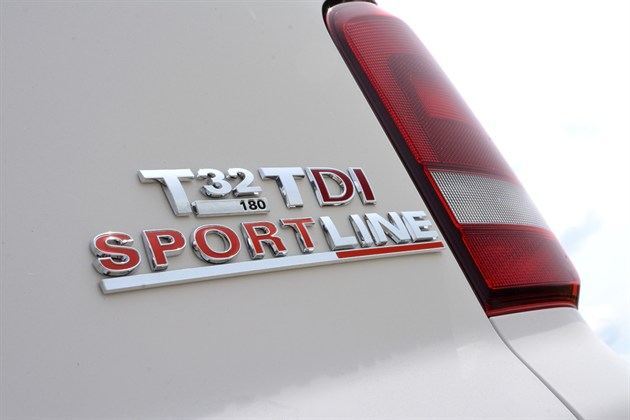
Most Transporters carry the T number on a badge at the back. In our photo, T32 sits right beside the TDI badge, but only the T32 part is about weight.
Treat the badge as a clue, not proof. Parkers, the van buying guide, says most Transporters carry the badge but advises checking the weight plate to be sure. The plate shows the maximum weight and the limit for each axle. Your V5C and the handbook can help too.
Our campervan payload guide shows where to find the plate and how to read every number on it, so we won’t repeat that here.
T26 vs T28 vs T30 vs T32
All of them look the same from the outside, so what changes? VW’s own figures show that the heavier codes come with higher axle limits, which means more room for weight. Take the T6. VW’s 2019 UK press pack gives the T26 short wheelbase van axle limits of 1,500kg front and 1,400kg rear. The T32 versions get 1,710kg front and 1,720kg rear.
Here is how that plays out for a T6.1 short wheelbase panel van, using VW’s official payload figures:
| Badge | GVW | T6.1 SWB panel van payload |
|---|---|---|
| T26 | 2,600kg | 713kg |
| T28 | 2,800kg | 836kg to 913kg |
| T30 | 3,000kg | 996kg to 1,113kg |
| T32 | 3,200kg | 1,085kg to 1,309kg |
The range within each code comes down to engine, gearbox and trim. Long wheelbase vans have less payload than short ones at the same code, because the van itself weighs more. These are empty panel van figures, before anyone fits a bed, a kitchen or a pop top.
One more catch: VW’s unladen weight includes a 75kg driver and about 90% of a tank of fuel. So the payload in a VW brochure covers passengers and kit, because the driver is already counted.
Older and newer Transporters
The system is not new. When the T5 arrived in 2003, VW sold the range as T28, T30 and T32. VW’s 2013 UK brochure for the T5 lists the T30 at 3,000kg and the T32 at 3,200kg, the same as later vans.
The latest Transporter, on sale since 2025, is a different van. It shares its platform with the Ford Transit Custom, but VW still names the diesels T28, T30 and T32. They are 2.8, 3.0 and 3.2 tonnes. The electric e-Transporter comes as a T32 or a T34, at 3.4 tonnes. VW UK quotes up to 1,274kg payload for the diesel panel van.
Why it matters if you convert
A camper conversion adds a lot of weight that never shows up in a brochure. Think furniture, a bed, a pop top, water, gas, batteries and all the stuff you take for a weekend away. A van with a low T number runs out of payload much sooner.
Converters tend to steer people away from the T26. One UK converter warns that a T26 with a full conversion can end up close to, or even over, its limit. Another prefers a T30, says a T28 works if you keep an eye on water and batteries, and notes the T32 has chassis differences that make some conversion options tricky. So do your sums before you buy.
The T number also matters when you buy parts. Lowering springs, coilovers and lift kits often come in different versions for different weight classes. Wheels and tyres need a load rating that covers your axle weights. Our guide to T5 and T6 wheels, tyres, suspension and lift kits goes into that.
The payload guide covers the rest, including licences, weighbridges and what to do if you need a different plated weight. For quick reference, every T number here sits under the 3,500kg limit for a category B car licence. That applies if you passed your test on or after 1 January 1997.
Common mix-ups
- GVW is not payload. A T30 can weigh 3,000kg in total. It cannot carry 3,000kg.
- The T number is not the engine. On the van in our photo, the TDI badge sits right beside it.
- It is not a trim level. Startline, Highline and Sportline are trims. The van in our photo is a T32 and a Sportline, and each badge means something different.
- The badge is not the final word. Always check the weight plate.
- A higher T number is not just for heavy work vans. It simply means more headroom on weight, which suits campers.
- MOT class can change. A goods van over 3,000kg, such as a T32 panel van, takes a Class 7 MOT. A van registered as a motor caravan goes in Class 4.
Related reading
- Campervan payload explained: plates, axle limits, licences and weighbridges.
- VW T5 and T6 wheels, tyres, suspension and lift kits: PCD, tyre load ratings and suspension by T number.
- Looking to buy a VW T5?
- Buying a VW T4 Transporter, if you fancy something older.
Bottom line
T26, T27, T28, T30, T32 and T34 are weight codes. The number is the van’s gross vehicle weight in hundreds of kilos, so a T28 is 2,800kg and a T32 is 3,200kg. It is not the payload, the engine or the trim. Check the weight plate rather than the badge. If you are converting, a higher T number gives you more room for a bed, a kitchen and your kit.
Still not sure which T number suits your build? Ask in the Dubbed Out community on Facebook. It comes up a lot in the group, so you won’t be the first to ask.