

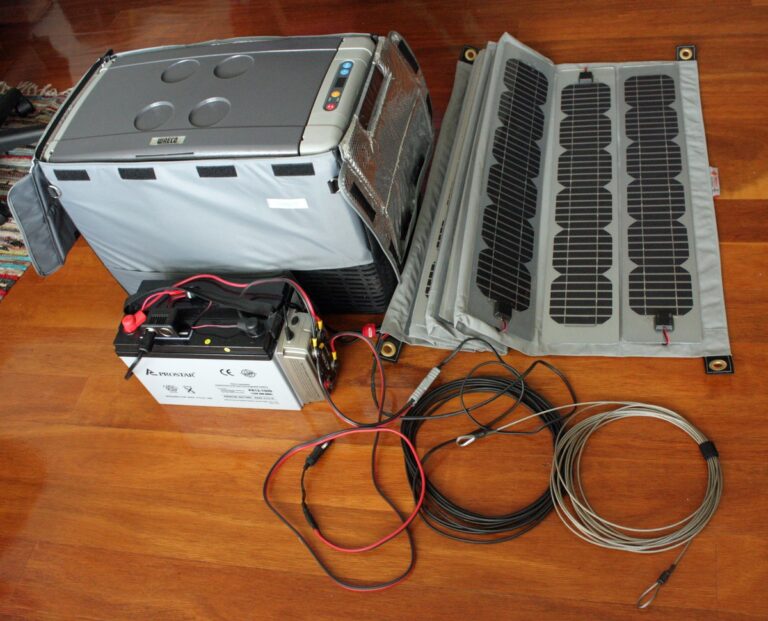
The lights, the fridge and the heater all want the same thing from your campervan electrics: a healthy 12V system. For winter trips, start with our winter campervan camping guide. For the heater itself, see our campervan diesel heater guide.
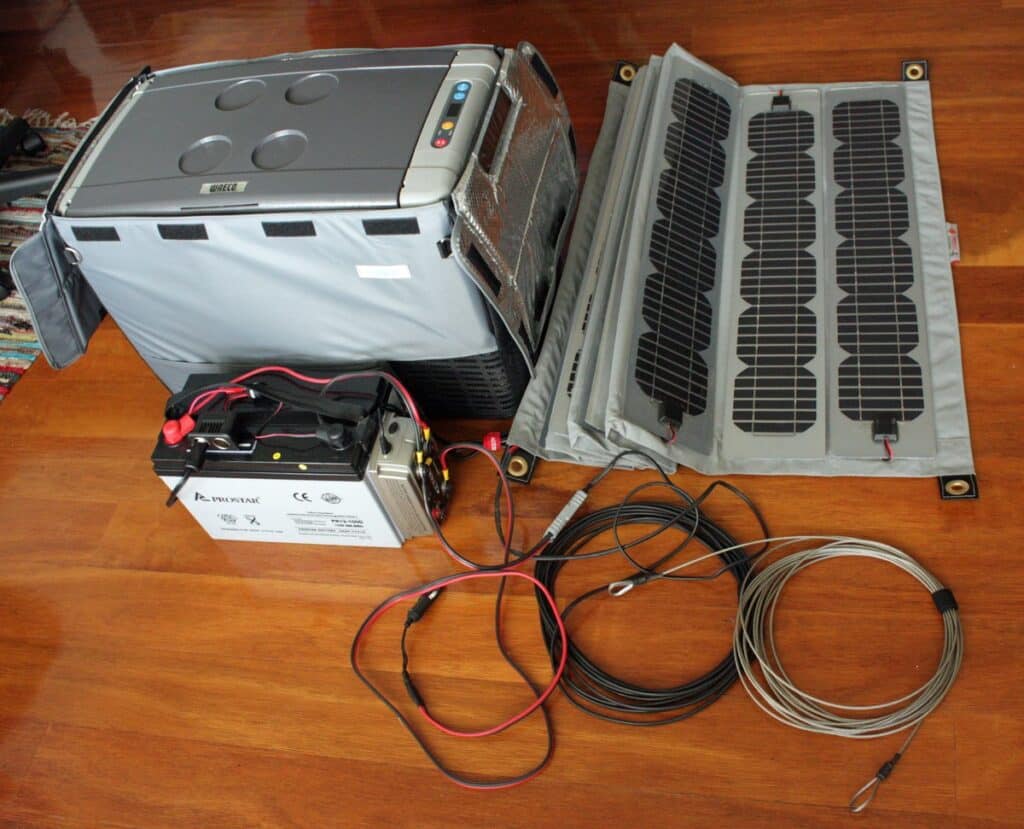
Photo: Stephan Ridgway, CC BY 2.0.
Starter battery vs leisure battery
Your starter battery has one job: it starts the engine and gets you home. The leisure battery runs the camper kit: lights, fridge, pump, USB sockets and the heater’s fan and pump. A car battery gives a short burst. A leisure battery covers a steady drain. The Camping and Caravanning Club is clear: do not ask one battery to do both jobs.
What the 12V system actually does
Lights, the water pump and phone charging all sip from the leisure battery. A diesel heater needs a bit of 12V too. Once it is running, that is around 10 to 30 watts, as we set out in the heater guide. The fridge adds up, as it can cycle all day. Work out what you actually use, then size the battery around that. See also our guide to buying your first campervan.
Leisure battery types, in plain English
Most older vans still run a lead-acid leisure battery. Makers often want a recharge once it falls to 50 per cent. Leave one sitting flat and it can sulphate, so it may never recover. The Club also notes that a typical lead-acid leisure battery is unlikely to last more than five years.
Gel batteries use a non-spill gel, and need a slightly lower charge voltage. The Club puts the cap at 14.2V. AGM batteries trap the acid in a glass-fibre mat. They usually last more charge cycles than a wet lead-acid battery. Charge voltage should not go above 14.4V. Check the maker’s figure too.
Lithium batteries: LiFePO4 in plain English
The lithium batteries you want in a van are lithium iron phosphate, or LiFePO4. That is a different chemistry from the packs in phones and e-bikes.
Weight, capacity, cost and life
A typical LiFePO4 battery is about half the weight of a lead-acid battery with a similar rating. Every kilo comes off your payload, as our payload guide explains.
Lead-acid wants a recharge at half full. The Club says you can get nearly twice the capacity from the same rating. Its winter advice notes you can take one down to 20 per cent. They also hold a steadier voltage as they empty, and they recharge faster.
Lithium can cost more than three times as much as a good lead-acid battery, says the Club. It should last significantly longer, though. It is also less likely to suffer if it sits without a charge over winter.
Chargers, the BMS and cold weather
Most drop-in LiFePO4 batteries have a battery management system, or BMS, built in. It looks after charging and discharging. Some systems use a separate BMS instead. Either way, never run lithium without one. The battery needs a compatible charger, with a lithium setting. Do not use a lead-acid charger that has a recondition or desulphate mode. The Club says that can permanently damage a lithium battery. The same idea applies to a solar controller and a DC-DC charger on the alternator.
Do not charge these batteries below freezing. Some makers set the limit higher, at 5°C, so check yours. If yours lives somewhere that can freeze, you need one with an internal heater. Or keep it above freezing before it charges. Quality varies, so buy from a reputable seller.
Swapping to lithium: it is not just a battery swap
Here is the bit people miss. You cannot just drop a lithium battery where the old one sat and drive off. Your wiring, fuses, fridge and lights can usually stay. The kit that charges the battery is a different story.
- Mains charger: it needs a lithium (LiFePO4) setting. Many older chargers do not have one.
- Charging on the move: a simple split-charge relay usually makes way for a DC-DC charger. Lithium can pull a lot of current, which can work the alternator hard.
- Solar controller: it needs a lithium profile. Most decent MPPT controllers have one, but check.
- Battery monitor: lithium holds a steady voltage until it is nearly empty. A simple voltage gauge will not tell you much, so a shunt-type monitor is worth adding.
- Cold: it cannot take a charge below freezing, unless it has a built-in heater. Some makers say 5°C, so check yours.
So budget for the battery and the charging kit together. If you are not sure what your van already has, ask a qualified installer to check before you buy.
How your campervan electrics get charged
Driving
While you drive, the alternator can top up the leisure battery. A simple split-charge relay joins the two batteries once the engine is running. A battery-to-battery charger, also called a DC-DC charger, does a more controlled job. The Club says these manage the charge and can deal with different battery types. For lithium, that controlled charge is the one you want.
Many newer vans, including Euro 5 and Euro 6 models, have a smart alternator. Its voltage varies, and it can switch off on the move. A DC-DC charger copes with that. It also stops a lithium battery overloading the alternator.
Solar
A roof panel, or a portable one you can tilt at the sun, will trickle charge through a regulator. Do not feed a decent-sized panel straight into a battery. The Club rates MPPT as the most advanced type of controller. It gets more out of the panel, especially in winter and on cloudy days.
The Caravan and Motorhome Club’s table has a 100W panel making 600 to 700Wh over a summer day. In winter, the same panel makes about 90Wh. The Camping and Caravanning Club says short, overcast winter days can reduce a large fixed panel to a trickle. For winter, plan on driving or hook-up as well, starting with our list of UK campsites open all winter.
Hook-up
On a campsite, a hook-up charger fills the leisure battery from the 230V supply.
Hook-up: the 230V bit
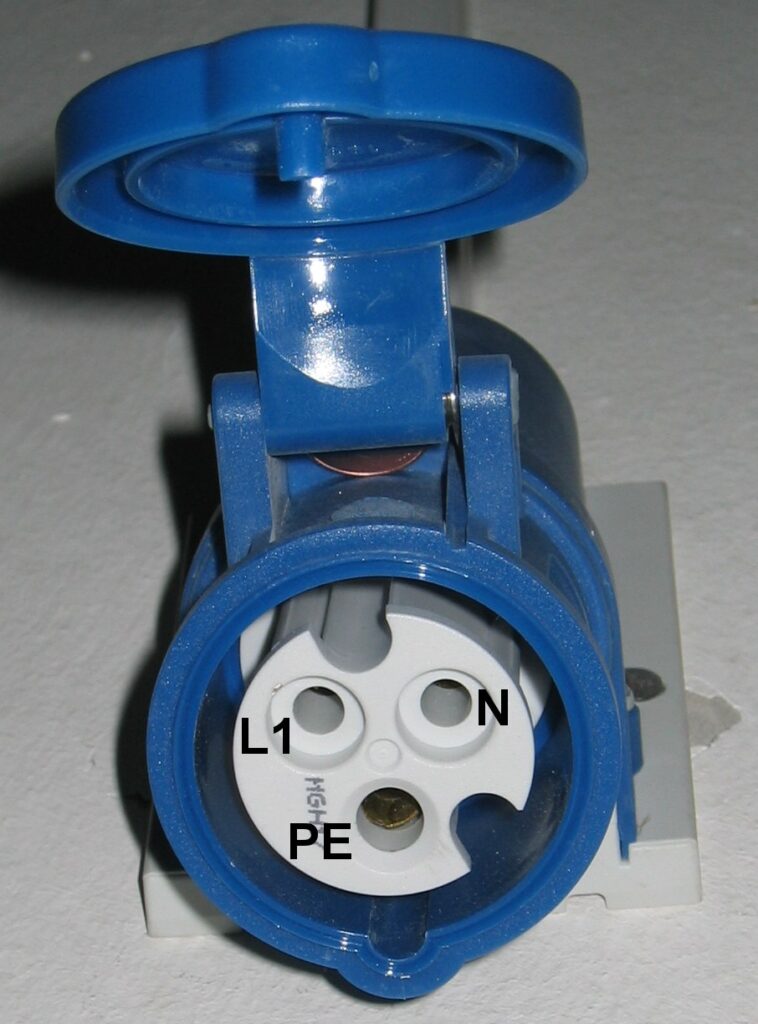
Photo: RalfZ, public domain, via Wikimedia Commons.
UK site hook-up is a nominal 230V supply. Many Camping and Caravanning Club sites offer 10A or 16A. Some smaller sites offer as little as 5A. A 10A pitch can supply about 2,300 watts. A 16A pitch can supply about 3.68kW. An ordinary kitchen kettle can draw 10A or more on its own, and can trip the bollard.
The cable
The Caravan and Motorhome Club sets out the Wiring Regulations on hook-up leads. They want a continuous lead of 25 metres, plus or minus 2 metres. It should have 2.5mm² copper cores and blue connectors to BS EN 60309-2. Shorter leads and joined extras are out. The joints are only splash-proof. Unwind the cable fully, so it does not overheat on the reel.
To connect, switch off the RCD in the van. Plug the cable into the van first, then into the bollard. Switch the RCD back on and press its test button. If it does not trip, get the system checked before you use it. When you leave, switch off your appliances and the RCD. Unplug at the bollard first, then at the van.
A few hard rules:
- Never use taped joints or ordinary 13A household plugs and sockets on a hook-up lead.
- Do not use splitter cables. Plug extra kit into the van’s own sockets, behind its RCD.
- Check the lead every time. Replace a damaged or scorched lead. Do not tape it up.
- Abroad, many sites supply only 5A or 6A. Some sockets have reversed polarity. A cheap plug-in mains tester will show it. If it shows an earth fault, do not use that supply.
Going fully electric, without gas
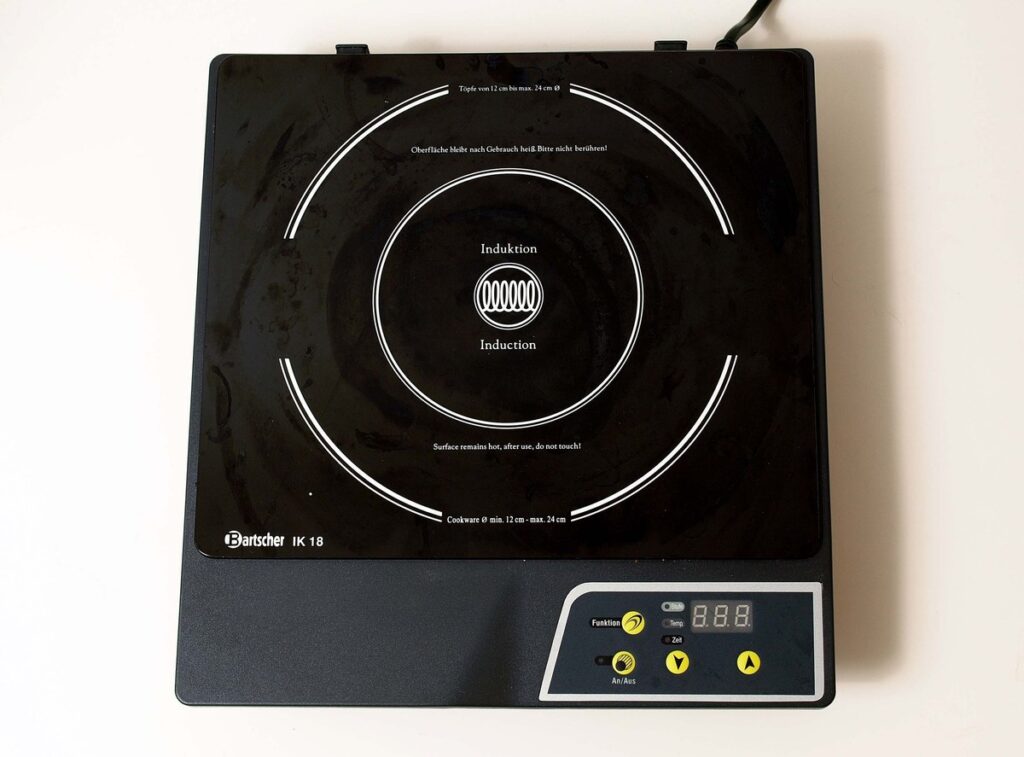
Some owners now drop the gas bottle and cook on an induction hob. The fridge, lights and kit then run from a larger lithium bank. There are no bottles to fill, and no gas installation to have checked.
The power budget
An induction hob is a hungry 230V load. The hob in our photo, a Bartscher IK 18, has a maker’s rating of 1,800 watts on 230V. An inverter turns 12V into 230V for that hob, and wastes a little on the way. The Camping and Caravanning Club’s example is simple. 100 watts of 230V needs about 120 watts, or 10 amps, from the battery. Scale that up. An 1,800W hob at full chat is around 180 amps from a 12V battery while it boils. That is a short, sharp drain, not an all-day one. The inverter still has to be big enough for the hob. The lithium bank has to shrug it off.
Inverter safety
An inverter turns your battery into a mains supply. Treat it with the same respect.
- Buy a pure sine wave inverter. It copies mains power and runs any load safely. A cheaper modified sine wave unit can upset chargers and sensitive kit.
- Wire it straight to the leisure battery through a fuse. Keep the cables short and thick enough for the current. At 180 amps, thin cable gets hot fast.
- Never connect an inverter’s output to your hook-up inlet or the van’s mains wiring. The Camping and Caravanning Club warns the inverter may even catch fire.
- Want the van’s own sockets to run from the inverter? That needs a properly designed changeover. Leave it to a qualified installer.
- 230V from an inverter can kill, just like mains. The same care applies.
- Do not rely on an inverter alone for vital medical kit, such as a CPAP machine.
Keeping up with demand
To keep up, you will usually want more solar. A decent DC-DC charger helps, so drives put energy back quickly. Regular hook-up helps too. It costs more than a simple lead-acid and gas setup, and you have to watch the numbers.
Electric heating eats power, so a lot of “electric” vans still run a diesel heater. It sips fuel and only needs a little 12V. Our diesel heater guide covers it. For any 230V work, including an inverter, use a qualified installer. We will not name names. Pick someone who knows vehicle electrics and will test the finished job.
Safety, in short
Twelve volts is unlikely to give you a dangerous shock. It can still start a fire. Thin or unfused cables can overheat, and a short across the terminals can set things alight. The Club says incorrectly wired 12V systems can cause fires. Get advice on wiring and fuses unless you know what you are doing. Mains 230V needs proper protection, including an RCD. Section 721 of BS 7671 covers electrical installations in caravans and motor caravans. That is a signpost, not legal advice. Have mains work inspected by a qualified person.
The battery and its fuses
- Lithium battery terminals are always live. Keep tools, watches and rings away from them, and use insulated tools.
- Bolt the battery down. A loose battery can become a projectile in a crash.
- Every circuit needs its own fuse in the positive cable, behind a main battery fuse.
- A lithium battery can push a huge current into a short. Its main fuse must have a high enough breaking rating.
- To work on the system, isolate the battery first. Pull the main fuse, or use an isolator switch rated for the load.
- A wet lead-acid battery gives off hydrogen as it charges. Keep its vent tube fitted and leading outside.
- LiFePO4 is the safer lithium type, but not risk-free. A damaged or overcharged one can give off harmful gases. Never use a damaged battery.
Alarms and regular checks
Fit a smoke alarm and a carbon monoxide alarm, and test them regularly. Choose a CO alarm to BS EN 50291-2. A gas-free van with a diesel heater still needs one.
Most owners book an annual habitation check. It covers the 12V and 230V systems, the RCD and the alarms. Electrical Safety First recommends a full electrical inspection for caravans at least every three years. The Camping and Caravanning Club backs the same three-year check.
Insurance
A fitted electrical system is a modification. Tell your insurer. Which? warns that not declaring changes could invalidate your cover. Our campervan insurance guide explains more.
Bottom line
Good campervan electrics start with two batteries. Match the leisure battery to how you camp, then give it a way to charge: driving, solar and hook-up. Lithium iron phosphate is lighter and longer-lived than lead-acid. It costs more, and it needs the right charger and BMS. Do not charge it below freezing. A gas-free van can work if the inverter and battery are up to the job. Many of us still keep a diesel heater for warmth. Keep the cable to the standard, get 230V work done properly, and tell your insurer.
Got a tip or a hard lesson? Share it in the Dubbed Out Facebook community. For early news, join the newsletter in the footer of dubbedout.co.uk. For early ticket access, use dubbedoutfestival.co.uk. Tickets go on sale through Ticket Tent on 31 January 2027.


