

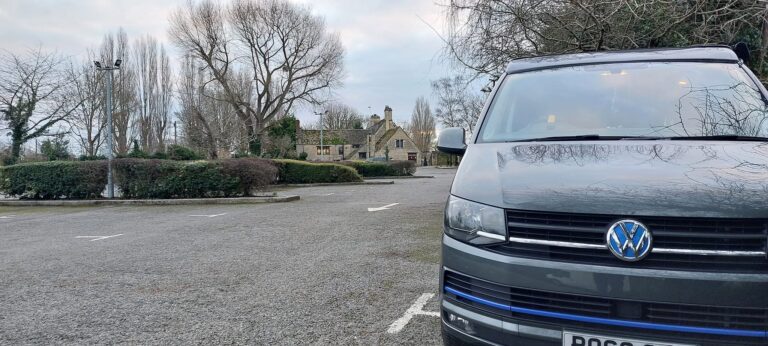
Every year, once the clocks go back, the same question pops up in the group: “Is it worth taking the van out in winter?” We think so. Quieter sites, crisp walks, dark skies and a pub fire at the end of the day all take some beating.
Winter camping does need a bit more planning, though. Lots of campsites close from autumn to spring, the rules on overnight
t parking are stricter than many people think, and cold nights bring their own problems: frozen water, damp bedding and heaters that need treating with respect.
So this guide brings it all together for October to March: campsites across England, Scotland, Wales and Northern Ireland that say they open through the winter, pub campsites and pub stopovers, what the law actually says about wild camping in a van, and the practical bits that keep you warm, dry and safe. Whether you’re in a classic VW, a modern Transporter, a Crafter, a Transit or anything else you can sleep in, it all applies.
A quick note before we star
t: we checked every campsite on its own website (or its official page) in October 2026. Winter opening can change at short notice because of weather, maintenance or private bookings, so always ring or email the site before you set off.
Campsites open through the winter
Here’s a selection from right across the UK. Each one says on its own website that it opens in winter and takes campervans. Where
a site has limits on van length, age groups or membership, we’ve flagged it.
England: the Lake District and the North
- The Quiet Site, Ullswater, Cumbria. Says it’s open all year, with all-weather, fully serviced pitches for tourers, motorhomes and VWs. Its bar says it’s open every day of the year. Tel: 01768 486337.
- Great Langdale Campsite (National Trust), near Ambleside, Cumbria. Takes bookings right through 2026 and 2027, apart from no arrivals 24 to 26 December 2026 and a closure on 24 to 26 December 2027. Campervans and motorhomes up to 6.5m, with hardstanding pitches with electric hook-up. Minimum stay is 2 nights, and there’s a pub a couple of minutes’ walk away. The campsite guide says to check for updates if the Met Office issues extreme weather warnings, and warns the site is prone to flooding in heavy rain. Check your van’s length, as many long-wheelbase vans are over 6.5m.
- Sykeside Camping Park, Brotherswater, Patterdale, Cumbria. Open all year round apart from the Christmas period. Its five hardstanding pitches with electric hook-up are run as a Caravan Club CL site for members’ caravans, campervans and motorhomes. There’s a pub on site (more on that below). Tel: 01768 482239.
- Herding Hill Farm, Haltwhistle, Northumberland (Hadrian’s Wall). Says the campsite is open all year. Hardstanding touring pitches have 16A or 10A electric, and the grass tent pitches only open from Easter to October. Tel: 01434 320175.
- Orcaber Farm, Austwick, near Settle, Yorkshire Dales. Campsite, caravans and pods open all year round. Every caravan pitch has its own water tap, electric and grey waste drain. The on-site shop only opens from Easter to the end of September. Tel: 07800 624994.
- The Dalesbridge, Austwick, Yorkshire Dales. Open all year, with electric hook-up points and some all-weather hardstanding. Its winter camping page welcomes motorhomes and campervans and mentions heated showers and a weekend bar with a log burner.
England: the Peak District
- Longnor Wood Holiday Park, near Buxton, Derbyshire. Open all year except January, when it closes for maintenance. All-weather hardstanding pitches with 10amp electric. Adults only. Tel: 01298 83648.
- Brundcliffe Farm Caravan Site, off the Buxton to Ashbourne road. A small five-pitch farm site, open all year round, with electric hook-up, three hardstanding pitches and a separate hardstanding area for motorhomes and campervans. Tel: 01298 84382 or 07855 893267.
- The Royal Oak, Hurdlow, near Buxton. A pub campsite that’s open all year (see the pub section below). Small campervans only, up to 5.3m long and 2m wide.
England: the South
- Bagwell Farm Touring Park, Chickerell, Weymouth, Dorset. Open all year, with a heated toilet and shower block open all year and hardstanding super pitches “good to use all winter” with 16-amp hook-up. The bar and grill opens from Easter to October. Tel: 01305 782575.
- Hurst View Leisure, Lymington, Hampshire (New Forest coast). Its FAQ says it’s open every day of the year, including Christmas Day, and it welcomes tents, tourers and motorhomes. Tel: 01590 671648.
Wales
- Dolgam, between Betws-y-Coed and Capel Curig, Eryri (Snowdonia). A riverside farm campsite, open all year round, welcoming campervans and motorhomes. Book hardstanding and electric hook-up in advance. As a working farm, it doesn’t accept dogs.
- Tan-y-Fron Holiday Park, Dolgellau, Eryri. Open all year round. It has nine fully serviced hardstanding pitches and centrally heated toilets, and it welcomes caravans, motorhomes and small campervans. It’s half a mile from the town’s shops and pubs.
- Snowdonia Parc, Waunfawr, near Caernarfon. A pub campsite (see below). Its page says it’s open all year but also “open most of the year”, so check your dates with them.
- Hungerford Farm, near Tenby, Pembrokeshire. A family-run touring caravan, motorhome and campervan site that says it’s “open all year round”. Tel: 01834 891463 (9am to 6pm).
Scotland
- Glen Nevis Caravan & Camping Park, Fort William. Says it’s “now open all year”, with information for stays from November to March. Tel: 01397 702191.
- Garlyne Brae, near Nethy Bridge, Cairngorms. A small campervan and motorhome site on a working farm, open all year round. All 12 hardstanding pitches have water and electric hook-up.
Northern Ireland
- Tollymore Forest Park, near Newcastle, County Down. The official nidirect page says it’s open all year round for camping and touring vehicles, including campervans. Touring pitches are tarmac with electric hook-up. There may be short closures in severe winter weather, such as heavy snow or strong winds.
Pub campsites and pub stopovers
Ending the day with a pint by the fire, then strolling back to the van, is hard to beat in winter. These have a pub on site or right next door and say they’re open in winter:
- Brotherswater Inn at Sykeside, Lake District. The site says the pub is open every day throughout the year except Christmas Day. It does drinks from 4pm and food in the evenings, plus lunch at weekends. Booking is essential for dinner. Dogs are welcome in the bar. Remember, the van pitches are a Caravan Club CL site.
- The Royal Oak, Hurdlow, Peak District. Its campsite is open all year round, behind the pub, with direct access to the Tissington and High Peak Trails. From November to March it uses its car park as hardstanding for small campervans up to 5.3m. The car park has a slight slope, so bring levellers. Facilities are cut back in winter to protect them from freezing. No caravans, motorhomes or electric hook-ups. Booking a table at the pub is recommended.
- Snowdonia Parc, Waunfawr, Eryri. Takes tents, touring caravans and motorhomes next to its pub, by the Welsh Highland Railway station. Hook-ups are 6 amp, and the site’s own notes say these suit “1000W camping heaters” but not electric heaters above 1400W. Check winter dates when you book.
- The Dalesbridge, Yorkshire Dales. Not a pub, but it has an on-site bar. Its winter page says the bar opens at weekends, with a log burner going.
- Great Langdale, Lake District. The National Trust says the nearest pub is “just a couple of minutes away on foot”.
Pub stopovers without a campsite. Brit Stops is a membership scheme with a yearly fee. It lists more than 1,200 stopover locations across the UK and Ireland, including pubs, farm shops and attractions, where members can stay overnight with no extra fee. Hosts set their own rules, so check each listing (and ring ahead in winter). And always check with the pub before stopping overnight in any pub car park.
Can you wild camp in a campervan? What the rules say
This is the one people get wrong most often, and the rules are different in each nation. Here’s what the official sources say.
England
The government’s Countryside Code, which covers England and Wales, says that camping is one of the activities you may need the landowner’s permission for. In practice, that means using a campsite, a pub or farm stopover, or land where the owner has said yes.
Dartmoor: the famous exception (but not for vans)
Dartmoor is the well-known exception: in some areas you can backpack camp without asking the landowner first. Even that is for tents, not vans. The Dartmoor National Park camping page says backpack camping means carrying everything in your backpack for one or two nights in areas shown on its camping map. For vans it’s clear: “overnight sleeping in vehicles at the roadside or in car parks is not permitted under National Park byelaws.” It says designated campsites are a must for campervans and motorhomes. Pulling into a layby for a cuppa and the view is fine.
Wales
The Natural Resources Wales version of the Countryside Code also lists camping as something you may need the landowner’s permission for. In Eryri (Snowdonia), the National Park’s camping page puts it plainly: wild camping isn’t permitted anywhere in Eryri without prior permission from the landowner or farmer, camping in car parks or on roadside verges isn’t allowed at any time, and staying overnight in a car park in a campervan isn’t permitted. The good news is that it also says most of Eryri’s official campsites are suitable for campervans.
Scotland
Scotland’s access rights are famous, but they’re about lightweight camping in a tent. The Scottish Outdoor Access Code’s camping guide says you can do lightweight camping “in a tent, in small numbers and for no more than two or three nights in one place”. It also says: “Remember that access rights don’t include motor vehicles. If landowners restrict or regulate parking on their land, you must respect this.” So a van isn’t covered by the same right. Plan to use campsites and places where overnight parking is allowed. Our guide to the Scottish Outdoor Access Code for campervans goes into more detail.
Loch Lomond & The Trossachs: the winter difference
Loch Lomond & The Trossachs National Park has seasonal Camping Management Zones from 1 March to 30 September. During that time, you need a campsite or a permit to camp, or to stay overnight in a van, in those zones. The National Park’s motorhome page says the byelaws have ended for this season, and that between 1 October 2026 and 28 February 2027 you don’t need a permit to stay in the busy lochshore areas. You still need to follow the Scottish Outdoor Access Code. The same page says the Park Authority’s own campsites at Loch Chon, Loch Achray, Inchcailloch and Sallochy are closed for now. It also asks you never to park overnight in passing places, not to use laybys for extended stays, and to use proper facilities for chemical toilet waste. Forestry and Land Scotland’s “Stay the Night” car park scheme only runs from 1 April to 31 October.
Wherever you are: leave no trace, never empty a chemical toilet anywhere but a proper disposal point, and have a campsite as a back-up plan.
Getting the van ready for winter
The Camping and Caravanning Club’s expert guide to winter touring has a handy checklist. Here are the highlights:
- Get it serviced. Winter conditions soon show up any weakness. Campervans need two services, one for the base vehicle and one for the habitation side, and it’s worth telling the habitation service agent you plan to use the van in cold weather.
- Antifreeze and screenwash. Make sure the cooling system has the right amount of antifreeze, and increase the concentration of your screenwash so it doesn’t freeze. Carry a scraper and de-icer.
- Tyres. The legal minimum tread is 1.6mm, but the Club says tyre experts recommend at least 4mm for winter motoring, and certainly no less than 3mm. Ideally fit winter tyres from November to March. All-season tyres are a compromise between the two.
- Fuel and an emergency kit. Keep enough fuel in the tank, and carry a warm blanket, a torch, food and drink, plus a phone and charger in case you get stranded. A grip mat and a shovel help if you get stuck on soft ground or snow.
- Pick a hardstanding pitch or reinforced grass where you can, plan your route on major roads when snow and ice are forecast, and slow right down when temperatures are near freezing.
- Before you head home, drain your fresh and waste water systems so nothing freezes in storage.
Our own campervan vehicle checks list is worth running through before any trip too.
AdBlue in the cold
Plenty of modern diesel vans use AdBlue. The RAC’s guide to AdBlue says that if the tank runs empty, many vehicles won’t restart once the engine is switched off. It also lists AdBlue that “has frozen in very cold weather and has not yet thawed” as one reason the warning light can come on.
- It freezes at about -11°C. UK supplier Greenox gives the freezing point as -11.5°C, and says freezing doesn’t affect the quality, so frozen AdBlue can be used once it’s thawed.
- Vehicles are designed for it. Engine maker Deutz’s technical circular says that because the freezing point is -11°C, the tank and lines are preheated when it’s cold. It also says AdBlue expands by up to 9% when it freezes.
- Store spare bottles sensibly. Greenox recommends keeping AdBlue out of direct sunlight and in a cool place. And never put it in the diesel tank: the RAC is clear that it isn’t a fuel additive.
- Check your own handbook for what your van does in sub-zero weather. Every system is a little different.
Keeping warm safely: heaters, gas and carbon monoxide
This is the bit we really want everyone to read. Carbon monoxide (CO) has no colour or smell, and the Camping and Caravanning Club’s camping safety advice warns that in high concentrations it can kill swiftly.
- Never use a cooker or hob to heat the van. The Club says stoves and barbecues are designed for cooking, not space heating. Its winter touring guide adds that using a gas oven and hob uses up oxygen and can create carbon monoxide, so open a window or roof light when cooking, and “never use a gas hob as an additional source of heating.”
- Never bring a barbecue inside, even one that’s cooling down. The Club says it still gives off plenty of carbon monoxide.
- Only use heaters designed for the job. The Club says never to run a gas, petrol or diesel-powered generator or heater that isn’t designed for the purpose inside a caravan, motorhome, tent or awning. Gas and kerosene heaters should only be used outside, unless they’re permanently fitted in a caravan or motorhome. If you have a fitted diesel or gas heater, keep it serviced as part of your habitation check.
- Fit a CO alarm and a smoke alarm. The Club recommends a CO alarm tested to BS EN50291-2 and Kitemarked, but says it should never replace the precautions above. It also recommends an optical smoke alarm approved to BS EN14604.
- Know the symptoms. The Club lists headaches, dizziness, feeling sick, tiredness and confusion, stomach pains and shortness of breath. Early CO poisoning can feel like flu or food poisoning, but without a high temperature.
- Don’t block the safety vents. The winter touring guide says the factory-fitted drop-out vents in the floor must never be covered, and flues and air intakes should be kept clear of snow.
Gas: use propane in winter
The Club explains that butane (usually in blue cylinders) stops giving off gas as the temperature nears 0°C. Propane (usually red) keeps working down to -40°C, and it says propane is essential at 4°C or lower.
Electric hook-up: watch the amps
Winter means heaters, lights and kettles all going at once, and hook-ups have limits. The Caravan and Motorhome Club’s winter touring tips work out that even a fan heater on its lowest 1kW setting draws about 4.35A. The Camping and Caravanning Club says a 2kW heater uses just over half of a 16A supply, and advises not to run your heater and kettle together. Check the amps when you book. Some winter sites on our list are 6A or 10A rather than 16A.
Beating condensation
Wake up to wet windows and a damp sleeping bag? You’re not alone. People breathe, cook and dry clothes in a small space, and all that moisture hits cold glass. The Camping and Caravanning Club’s winter touring guide says good ventilation and heating are the best way to stop condensation becoming a problem. Here’s how:
- Ventilate, even when it’s cold. Use extractor fans when cooking or washing, and never close off the safety vents.
- Cover the cab glass. Cab windows are single-glazed. The Club says snug external screens leave the glass warmer and cause less condensation. Internal screens are easier, but if they fit loosely, warm air reaches the cold glass and you get lots of condensation.
- A thick curtain between the cab and the living area also cuts down the space you need to heat.
- Keep the heating on low rather than off and then full blast. The Club says this is often better for comfort and economy when you go out for the day.
- Don’t rely on moisture-absorbing crystals while you’re using the van. The Club says they can’t keep up with the amount of moisture you produce.
- Dry wet gear outside the living space. The Caravan and Motorhome Club suggests drying wet coats, gloves and boots in the shower cubicle, and a small porch awning gives you somewhere to leave muddy wellies.
Water and power on frosty nights
- Bring water containers inside at night. The Caravan and Motorhome Club says this is the simplest way to stop them freezing. Keep a small container of water inside for that first cup of tea.
- Waste water freezes too. The Camping and Caravanning Club suggests leaving a motorhome’s waste valve open and draining into a bucket, because frozen waste in a bucket is far easier to deal with than a frozen tank.
- Look after the leisure battery. The Club says cold reduces battery capacity, and winter sun gives fixed solar panels only a trickle. Many heaters won’t run without battery power, so start with a fully charged battery, or book a hook-up. It adds that lithium (LiFePO4) batteries can’t be charged below zero, so you may need one with a built-in heater.
Visiting the UK from overseas?
- Check your licence. GOV.UK has a tool to see whether you can drive in Great Britain on a non-GB licence. Note that Great Britain means England, Wales and Scotland.
- Book ahead and call ahead. Winter sites are fewer and often small. Some have minimum stays (Great Langdale is two nights), size limits or adult-only rules.
- Remember the wild camping rules above. Sleeping in your van in car parks and laybys isn’t the free-for-all some visitors expect. In Dartmoor and Eryri, it’s specifically not allowed.
Where will you go this winter? Tell the community
Got a favourite winter campsite or a cosy pub stop we’ve missed? Share it in the Dubbed Out Facebook group. It’s full of owners of every kind of van who are happy to swap tips, and frosty van photos are always welcome.
Need more trip ideas? Try our campervan guides to the Lake District, the Peak District, Anglesey and Pembrokeshire. Setting the satnav to avoid motorways and tolls makes a short winter day feel like a proper adventure.
You can also follow along on our Facebook page, Instagram, TikTok and X.
Want community news in your inbox? Head to the Dubbed Out Festival information page and scroll to the bottom to sign up to our newsletter.
FAQ: winter campervan camping in the UK
Are there campsites open all year in the UK?
Yes. Plenty say so on their own websites, from Glen Nevis in the Highlands to Hurst View on the New Forest coast. Some close briefly over Christmas or in January, so always check your dates with the site.
Can I sleep in my campervan anywhere in the UK?
No. In England and Wales the Countryside Code says you may need the landowner’s permission to camp. Dartmoor and Eryri both say overnight sleeping in vehicles in car parks or at the roadside isn’t allowed. In Scotland, the Scottish Outdoor Access Code says access rights don’t include motor vehicles.
Do I need a permit for Loch Lomond in winter?
Not between 1 October 2026 and 28 February 2027, according to the National Park. The permit system for its Camping Management Zones runs from 1 March to 30 September. Follow the Scottish Outdoor Access Code all year.
At what temperature does AdBlue freeze?
At about -11°C. Greenox gives -11.5°C and says it can still be used once thawed. Check your van’s handbook for how its system copes in the cold.
Is it safe to use the gas hob to warm up the van?
No. The Camping and Caravanning Club says never to use a gas hob as an extra source of heating, and to ventilate when cooking. Use a properly fitted, serviced heater and fit a CO alarm.
Which gas should I use in winter?
Propane. The Camping and Caravanning Club says butane stops giving off gas as it approaches 0°C, while propane keeps working down to -40°C.
How do I stop condensation in my campervan?
Keep a little heat on and some ventilation open, use external screens on the cab glass if you can, and dry wet gear outside the living space. The Camping and Caravanning Club says good ventilation and heating are the best defence.