

The Channel is the easy bit. It is the stickers, the height bands and the 90-day clock that catch people out. You can book a crossing in ten minutes and still collect a fine in Lyon because the Crit’Air sticker is sitting in a kitchen drawer at home.
This is the complete UK prep list for taking a campervan to Europe, checked against official pages on 17 November 2026. It covers crossings, fares, paperwork, the kit you do not need in Britain, clean air zones, tolls, overnight stops, gas and hook-up. Always get a quote for your own van. Check official sites before you travel, because rules and prices move.
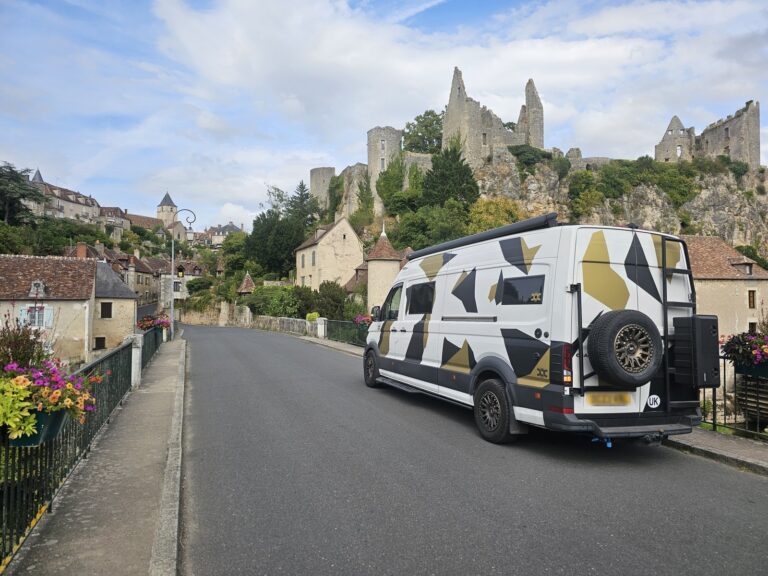
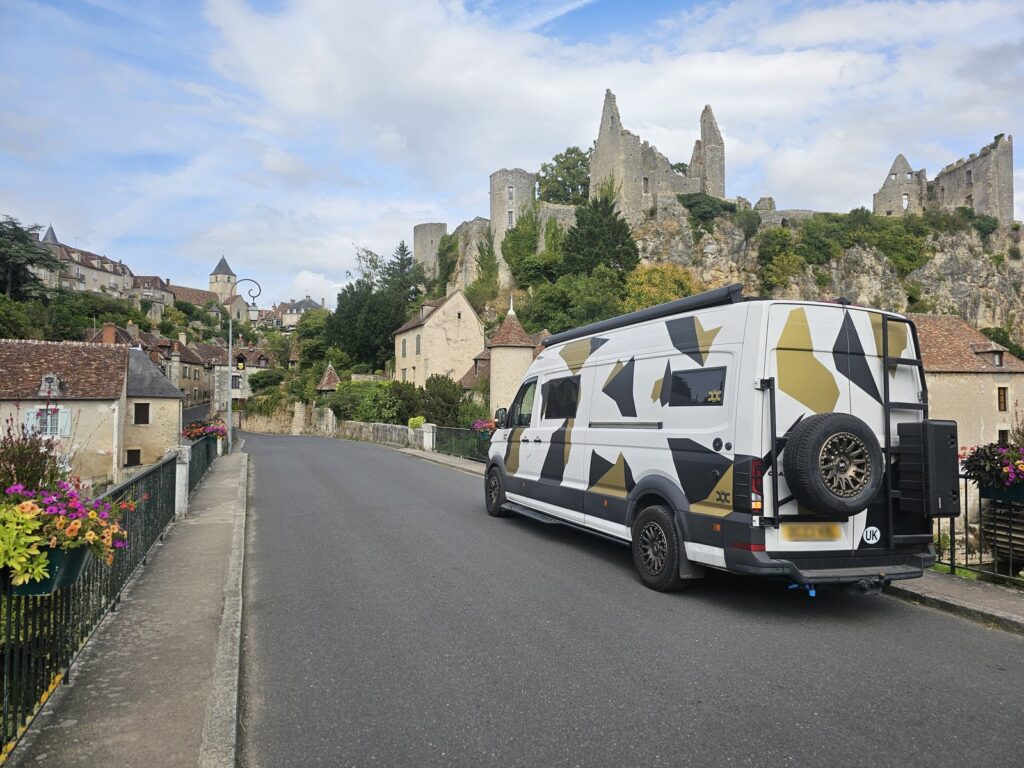 The Dubbed Out Crafter on a bridge beside castle ruins.
What do I need to take a campervan to Europe?
You need a valid passport, the V5C or a VE103 for a hired or leased van, and insurance that covers your route. Stay inside the Schengen 90-day limit in any 180 days. The EU Entry/Exit System is now in force, so allow extra time at the border. ETIAS is not in force yet. Any website selling it today is a scam.
Pack the kit the countries on your route actually require. Order a French Crit’Air sticker from the official site if you will enter a low emission zone. Buy Austrian or Swiss vignettes from official shops if you use those motorways. Measure the van as it will travel, including a roof box, bike rack or pop-top, then get a ferry or LeShuttle quote with those figures. A GHIC is free and useful, but it does not replace travel insurance.
If you are taking a dog, cat or ferret, get an Animal Health Certificate. Do not rely on an EU pet passport if you live in Great Britain. The full checklist sits at the end of this guide.
Which ferry or tunnel should I take?
Pick the crossing for the part of Europe you want, not just the cheapest advert. A short hop to Calais suits northern France, Belgium and Germany. A western sailing to Brittany, or a long crossing to Spain, can save a day of French toll roads. For routes once you are ashore, see our guide to avoiding motorways and tolls.
Which route is best for which region?
These are the main passenger routes on official operator sites on 17 November 2026.
| If you are heading for | Useful UK crossings | Why it helps |
|---|---|---|
| Northern France, Paris, Belgium, western Germany | LeShuttle Folkestone to Calais; Dover to Calais (P&O, DFDS, Irish Ferries); Dover to Dunkirk (DFDS) | The shortest, most frequent routes. Dunkirk sits a little further east |
| Normandy via Dieppe or Rouen | Newhaven to Dieppe (DFDS) | A 5-hour crossing that lands you in Normandy, not Calais |
| Brittany, the Loire, western and south-west France | Portsmouth to St Malo, Caen or Cherbourg; Poole to Cherbourg; Plymouth to Roscoff (Brittany Ferries) | Less driving through northern France |
| Spain, Portugal and south-west France | Portsmouth, Plymouth or Poole to Santander or Bilbao (Brittany Ferries) | A long overnight sailing, then a shorter drive and fewer French tolls |
| The Netherlands, Germany or Scandinavia from the north or east | Hull to Rotterdam (P&O); Newcastle to Amsterdam (DFDS); Harwich to Hook of Holland (Stena Line) | You start much closer to the Low Countries and beyond |
| The Alps, Italy, Switzerland or Austria | Any short Channel crossing, then drive | There is no direct UK to Italy passenger ferry for campers on these lists |
| Ireland, then on to France | Holyhead to Dublin; Fishguard to Rosslare; Pembroke to Rosslare; then Rosslare to Cherbourg or Dunkirk, Dublin to Cherbourg, or Cork to Roscoff | Ireland is not in Schengen, so EES does not apply there. It starts when you enter France |
How long are the western and Irish routes?
Irish Sea options also include Liverpool or Cairnryan to Belfast, and Cairnryan to Larne with P&O. Those land you in Northern Ireland, not the EU. Brittany Ferries also sails Bilbao to Rosslare. Western and Spanish crossings are long. Portsmouth to St Malo takes about 8 hours 45 minutes. Portsmouth to Santander or Bilbao takes about 24 hours. Plymouth to Santander takes about 19 hours. Book a cabin on overnight runs.
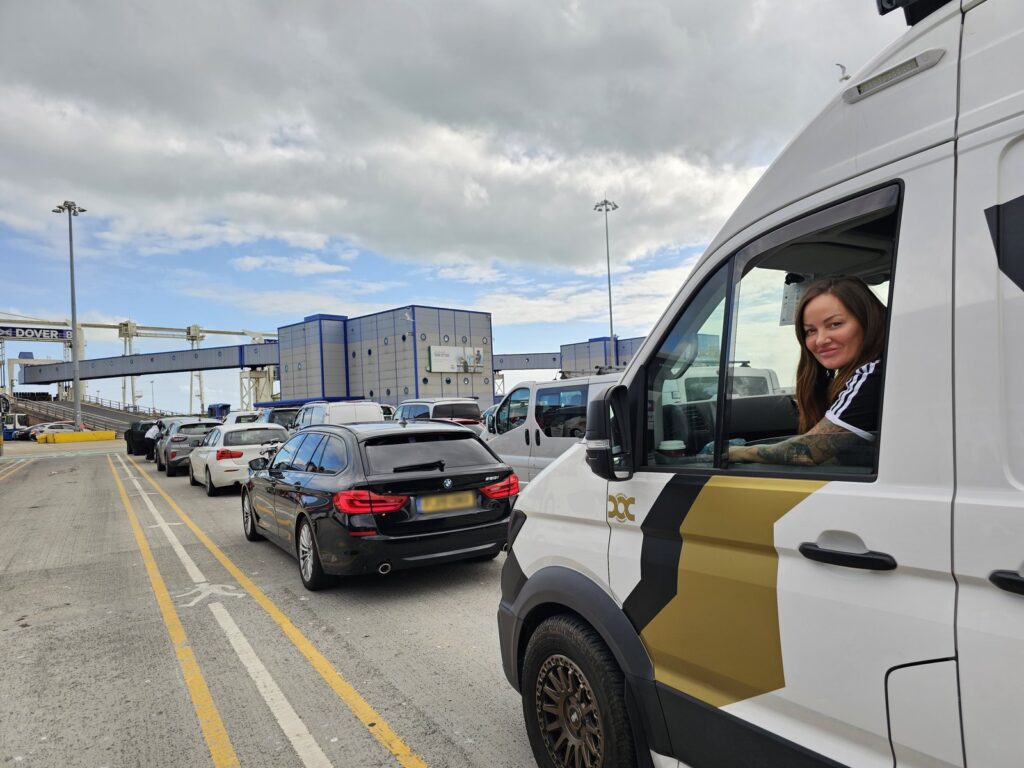 The Dubbed Out Crafter in the ferry queue at Dover, with the official Dover sign visible on the left.
How much does the ferry cost for a campervan?
We could not pull live camper quotes from the operator booking tools on 17 November 2026. We will not invent fares. Operators price a camper on height and length as the vehicle will travel, plus the date, time and ticket type. Weekend and school-holiday sailings cost more. A cabin on an overnight crossing is usually extra, and often compulsory at night.
How do height and length bands work?
LeShuttle splits vehicles at 1.85 metres high. Anything taller, including most pop-top campers with the roof down and almost every high-top, goes in a single-deck carriage. Official maximums are 4.2 metres high, 2.55 metres wide plus mirrors, and 18 metres for a vehicle and trailer combined. You must declare overall length, including a rear rack. Headline LeShuttle fares are based on an average car, a BMW 3 Series with no roof box. They are not a camper price. Get a quote for your van.
Ferry adverts that say “from £114” for Dover to Calais are typically for a car plus passengers. The same goes for similar starting prices for Hull, Newhaven or Newcastle. P&O and DFDS published those car figures on 17 November 2026. A van over the car height band, or a motorhome of 6 metres or more, sits in a dearer band. Put the pop-top down. Include the roof box, bike rack and rear rack in the measurement. If you turn up taller or longer than you booked, the operator can charge the difference or refuse to load you.
On LeShuttle, switch off gas appliances for the crossing. Domestic LPG tanks may travel if they hold no more than 47 kg and are less than 80% full. You may have to show that at the terminal. Vehicles that run on LPG, even as a second fuel, cannot use LeShuttle. Pets are an add-on, from £24 each way on the operator’s tickets page when we checked.
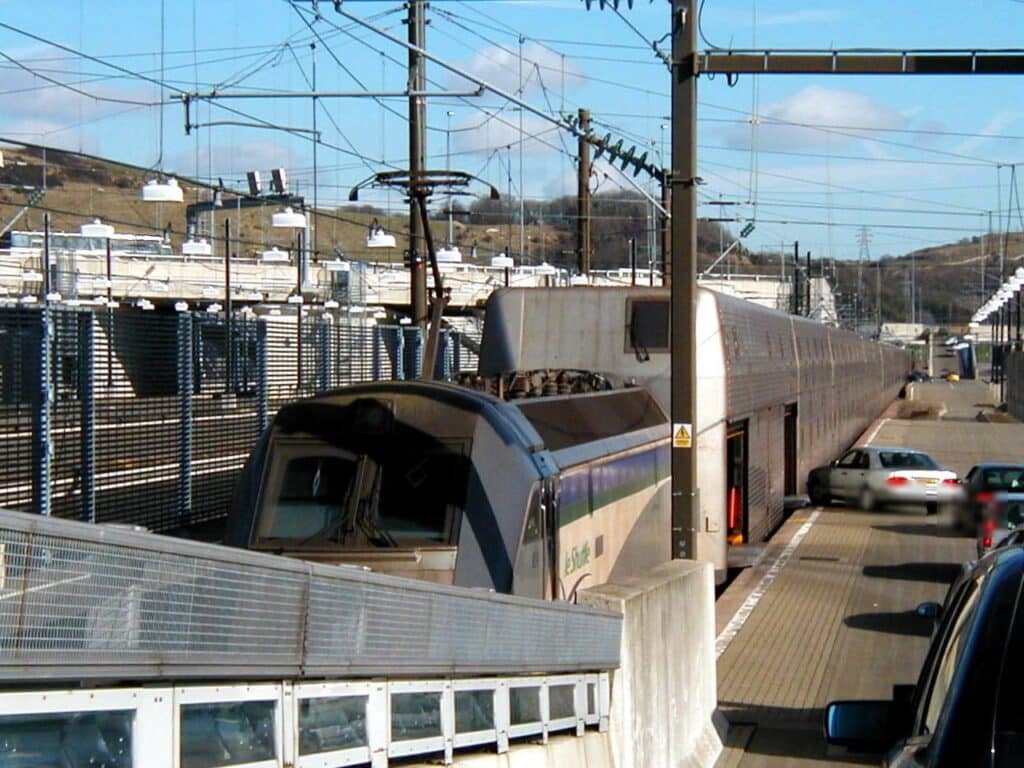 LeShuttle at Folkestone. Campers over 1.85 metres high use the taller single-deck carriages. EES checks for this crossing happen at the UK terminal before you leave. Photo: John Lucas, CC BY-SA 2.0, Wikimedia Commons.
What paperwork do I need?
Take a full British citizen passport that meets the Schengen rules. The date of issue must be less than 10 years before the day you arrive. The expiry date must be at least 3 months after the day you plan to leave the Schengen area. A passport issued before 1 October 2018 can fail the 10-year issue rule even if pages remain. Renew it if it is tight.
Carry the original V5C logbook. If you hire or lease the van, take a VE103. Carry your driving licence. A UK photocard licence is enough for the EU, Switzerland, Iceland and Liechtenstein. You do not need an International Driving Permit there if you have a photocard. You may need an IDP if you still have a paper licence, or a licence from Gibraltar, Guernsey, Jersey or the Isle of Man. An IDP costs £5.50 from certain PayPoint shops. You do not need one for Ireland if you hold a UK licence.
Do I need a green card, a UK sticker or a GHIC?
All UK motor insurance gives you minimum third-party cover in the EU, including Ireland, and in Andorra, Bosnia and Herzegovina, Iceland, Liechtenstein, Montenegro, Norway, Serbia and Switzerland. You do not need a green card in those countries, but you still need valid insurance. Ask whether your policy covers theft and damage abroad, or only the legal minimum. Some other countries still want a green card. Check before you add them to the route.
Display a UK sticker, not a GB one, unless your rear plate already has the UK identifier with the Union flag. You still need a UK sticker in Spain, Cyprus and Malta, whatever is on the plate. You do not need one in Ireland. Cover or remove an old GB sticker. Do not put the new one on the number plate.
A UK Global Health Insurance Card is free from the NHS. Apply at nhs.uk/ghic and ignore paid copycat sites. An existing UK EHIC still works until it expires. A GHIC helps with state healthcare in the EEA, but it is not travel insurance. It will not fly you home or cover private care or mountain rescue. Take both. UK-only breakdown cover often stops at the Channel, so add European cover if you can.
What are EES and ETIAS, and how long can I stay?
The EU Entry/Exit System started on 12 October 2025. It has been fully in force at external borders since 10 April 2026. If you travel on a UK passport for a short stay, border staff may take your fingerprints and a photo. There is no fee, and you do not apply in advance. The digital record lasts 3 years. They may also check you when you leave. Children aged 11 or under do not give fingerprints, but they may still have a photo taken. Allow extra time in peak season.
If you go through Dover, LeShuttle at Folkestone or Eurostar at St Pancras, you complete EES in the UK before you leave. On other ferries, and by air, you usually register on arrival. Ireland and Cyprus are not in Schengen, so EES does not apply there. Follow the operator and the port.
Is ETIAS in force, and what is the 90-day rule?
ETIAS is the planned travel authorisation for visa-free visitors, including UK passport holders. It is not in operation. The EU says it will announce the start date several months before launch, and nobody should apply yet. Official pages have set the fee at 20 euros for most adults aged 18 to 70 when it starts. There is no fee for under-18s and over-70s. Any site selling ETIAS now is a scam. Use only travel-europe.europa.eu when the EU says it is open.
You can stay in the Schengen area for 90 days in any 180-day period without a visa. That covers tourism, family visits and short business trips. The limit covers the area as a whole, not each country on its own. Days in Ireland do not count. Overstaying can lead to a ban of up to 3 years. French officers may also ask for proof of insurance, funds, accommodation or a return ticket. Use the official EU short-stay calculator if your dates are tight.
What kit do I need that I do not carry in the UK?
The UK does not make you carry a warning triangle or a hi-vis vest. Plenty of European countries do. Buy the kit before you go. A ferry terminal is a poor place to start shopping. Headlamp beams set for British roads will dazzle drivers on the continent. Fit beam deflectors, or use the vehicle’s beam-adjust setting, before you drive on the right.
Country-by-country requirements
| Country | What you need or should sort | Watch out for |
|---|---|---|
| France | CE-marked hi-vis vest within reach, approved warning triangle, Crit’Air sticker for low emission zones, headlamp adjusters | A breathalyser is not obligatory. Radar detectors are banned even to carry. Winter tyres or chains apply from 1 November to 31 March in designated mountain communes |
| Spain | UK sticker in every case, warning triangle, hi-vis. A connected V16 beacon is a good idea | From 1 January 2026 a connected V16 replaces triangles for Spanish-registered vehicles. Official DGT guidance still allows foreign vehicles to use triangles |
| Germany | Green Umweltplakette if you will enter an Umweltzone, ordered from TÜV, DEKRA or a licensing office with a copy of the V5C | You do not need it just to enter Germany. Most zones want the green sticker. The official fine for entering a zone without one is 80 euros |
| Italy | Pay motorway tolls as you go, or with Telepass. Register or buy a permit for any city ZTL before you drive in | Each town runs its own ZTL. Cameras fine you later. Winter tyres or chains often apply from 15 November to 15 April where signs say so |
France’s official service-public site, checked on 2 November 2026, is plain about two myths. You do not have to carry a breathalyser. You must not hold, carry or use a speed camera detector or warning device. The penalty can reach 1,500 euros, with seizure of the device. The drink-drive limit is 0.5 grams per litre, or 0.2 on a probationary licence. That is about a third lower than in England and Wales.
Austria, Switzerland, Belgium, the Netherlands and Scandinavia
| Country | What you need or should sort | Watch out for |
|---|---|---|
| Austria | Vignette for vehicles up to 3.5 tonnes, bought from official ASFINAG channels. Vehicles over 3.5 tonnes use a GO-Box mileage toll | 2026 prices: 10-day 12.80 euros, 2-month 32 euros, annual 106.80 euros, 1-day 9.60 euros. Digital annual and 2-month vignettes bought online start on the 18th day. Some alpine crossings add a section toll |
| Switzerland | Motorway vignette, 40 Swiss francs, valid 1 December 2025 to 31 January 2027. Buy the e-vignette from the official Via Portal at e-vignette.ch | There is no weekly vignette. Driving without one can mean a 200-franc fine plus the 40-franc vignette. Vehicles over 3.5 tonnes pay a heavy-vehicle charge |
| Belgium | Register a UK vehicle before you enter a low emission zone | Brussels has its own free register at lez.brussels. One Flanders registration covers Antwerp and Ghent, but it does not cover Brussels |
| Netherlands | Check each city’s milieuzone on milieuzones.nl | Diesel access depends on the emission class and how the vehicle is recorded. Amsterdam, Utrecht and The Hague are not identical |
| Scandinavia | Use the northern ferries, then check city tolls and low emission rules as you go | Wild camping is more open in parts of Norway and Sweden than in Denmark, but it is never a free-for-all. Follow local signs |
How do clean air zones work abroad?
European cities do not run on London’s daily-charge model. Many ban the wrong sticker or Euro standard, then film the plate and send a fine. If you already worry about ULEZ and UK Clean Air Zones, do the same homework here. Check the vehicle, then buy or register only on official sites.
How do I get a Crit’Air sticker?
In France, order a Crit’Air sticker only from certificat-air.gouv.fr. For a UK-registered van the official price is 5.11 euros, including postage. You upload a scan of the registration document and wait about 10 working days. Keep the emailed invoice in the van until the sticker arrives, and display it on the windscreen. A German Umweltplakette does not replace it. Unofficial sites sell the same sticker at a mark-up, or worse. Do not use them.
Each French ZFE sets its own banned categories, days and hours. A sign in one city is not a national rule. In Lyon in February 2025, the entry sign allowed electric vehicles and Crit’Air 1 and 2 only. Other cities draw the line differently. Read the sign on the way in, and check official French ZFE pages before a city stop.
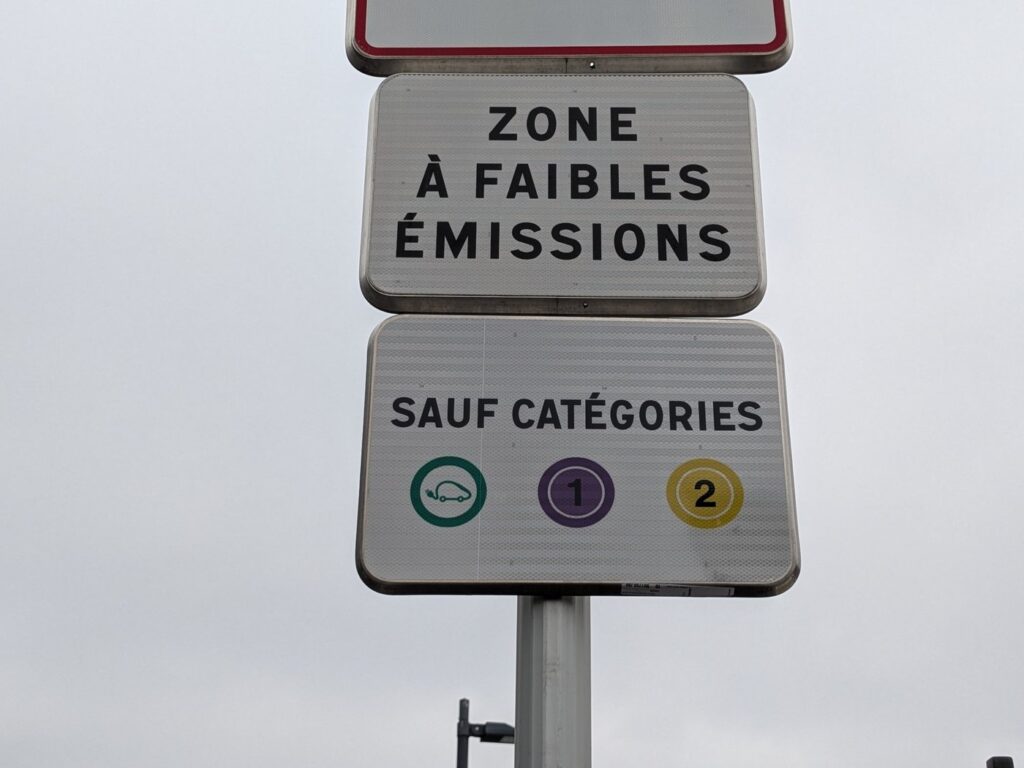 A low emission zone sign in Lyon, February 2025, allowing electric vehicles and Crit’Air categories 1 and 2. Other French cities set different limits, so always read the local signs. Photo: Sebleouf, CC BY-SA 4.0, Wikimedia Commons.
What about Germany, Belgium, the Netherlands, Spain and Italy?
In Germany, most Umweltzonen want the green sticker. That generally means Euro 4 diesel or better, or Euro 1 petrol or better. Electric vehicles go in the green group. Official guidance says offices usually charge 5 to 10 euros, plus postage if they post it. Order it before you go. In Belgium, register a foreign vehicle before you enter the zone, on the official Brussels or Flanders sites, not a reseller. In the Netherlands, use milieuzones.nl, because diesel rules vary by city and by whether the van is recorded as a car or a goods vehicle. In Spain, cities such as Madrid and Barcelona expect foreign vehicles to register for the ZBE on the official city site before entry. In Italy, a ZTL is a limited-traffic zone, not a pollution sticker. You need that town’s permit or ticket, or a camera will bill you later.
How do tolls and vignettes work for a campervan?
Height and weight change the bill. On French autoroutes, official SANEF classes are clear. Class 1 is a vehicle no more than 2 metres high and no more than 3.5 tonnes. Class 2 is over 2 metres and under 3 metres, still at or under 3.5 tonnes, which is most high-top campers. Class 3 is 3 metres or more, or over 3.5 tonnes, with two axles. Class 4 is the heavier, multi-axle group. A pop-top California that genuinely measures 1.99 metres with the roof down can stay in Class 1. A roof vent, solar panel or box can push the same van into Class 2. Pay with a card, cash or a télépéage badge, and use a lane that can take your height.
Italy charges by the motorway, not with a national vignette. Austria and Switzerland use time-based vignettes for lighter vehicles, as in the table above, plus extra Austrian section tolls on some alpine crossings. Buy only from official sites and booths. From the 2027 vignette year, Austria will sell the vignette in digital form only.
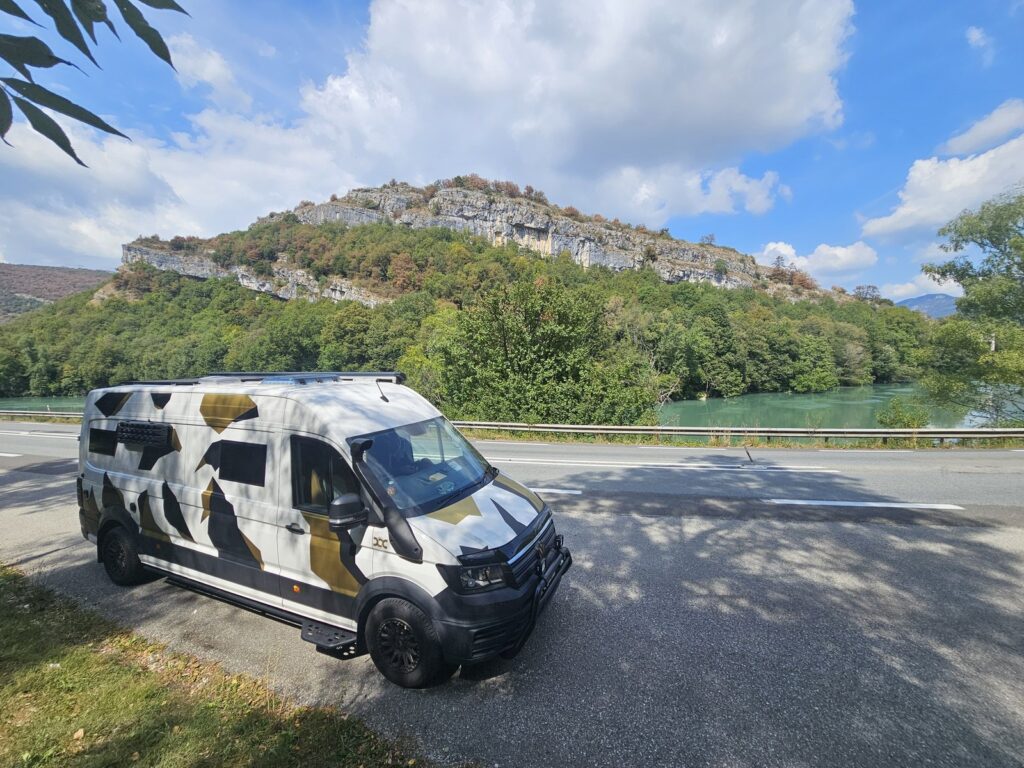 The Crafter parked beside a riverside road under a limestone cliff.
Where can I sleep, and can I wild camp?
France is the country most UK owners ask about first. Official French rules draw a useful line. Sleeping in a legally parked vehicle is generally not treated as camping. Putting out an awning, chairs, tables or levelling ramps usually is. Wild camping needs the landholder’s consent. It is banned on the seashore, on protected or listed sites, at historic monuments, and within 200 metres of a drinking-water point. Towns can also ban overnight parking. Use a signed aire or a campsite, and follow the posted time limit and fee.
Other countries are often stricter, especially on the Spanish coast and in much of Italy, Germany, Belgium and the Netherlands, where dedicated Stellplätze or aires exist for a reason. Parts of Norway and Sweden are more flexible under right-to-roam customs, with their own limits. Do not treat an app pin as a legal right. Park4Night, Campercontact and SearchforSites are useful for finding places other owners have used. Check the signs when you arrive. For the UK side of the same argument, see Can I sleep in my campervan anywhere in the UK?
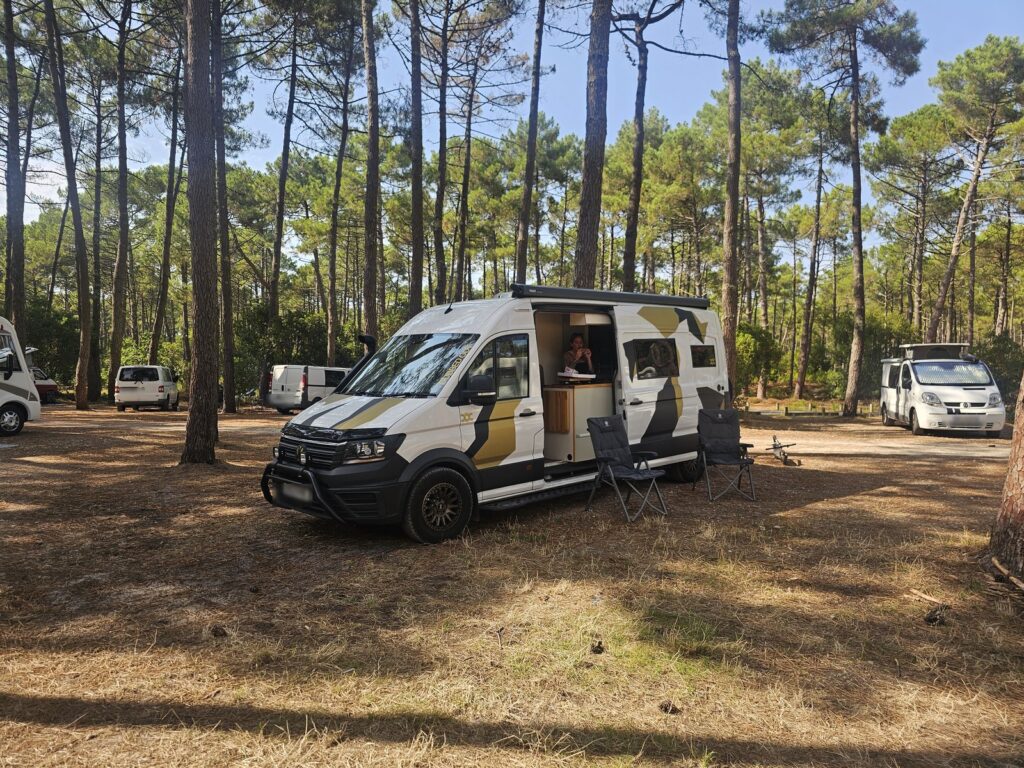 The Crafter and other vans on a pine-forest motorhome aire, with chairs out for the evening.
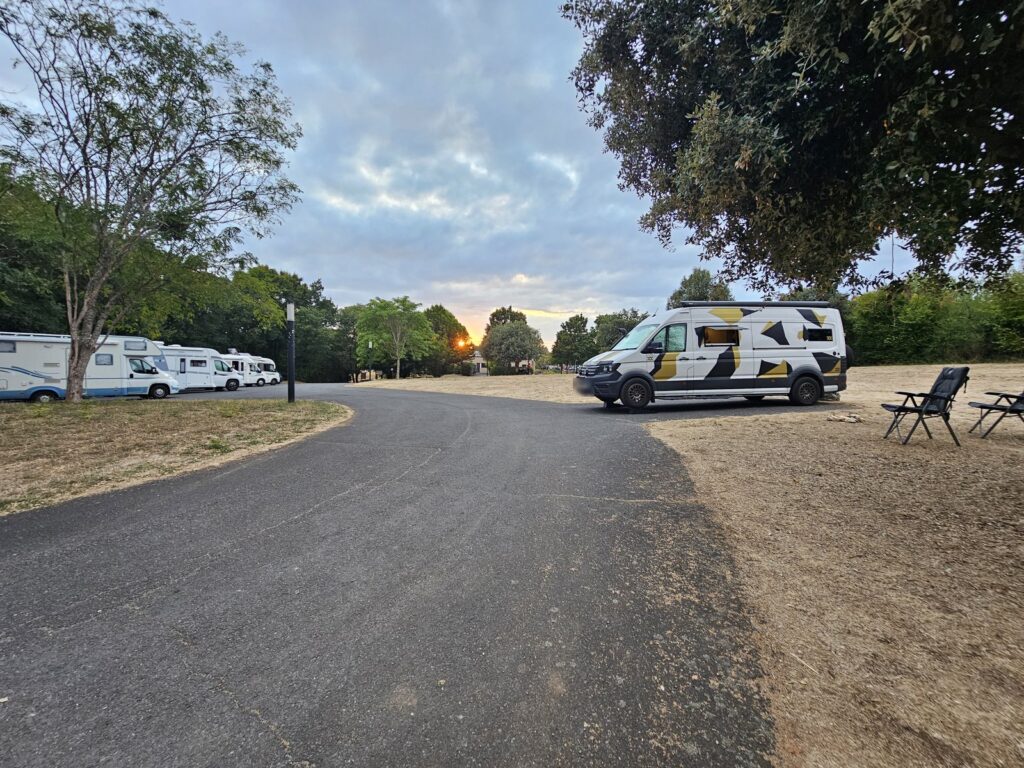 A motorhome aire at dusk, with chairs set out beside the vans.
What about gas, hook-up, fuel, money and your phone?
Calor UK cylinders are not part of the usual exchange network on the continent. A nearly empty Calor bottle is a poor travelling companion. Campingaz cylinders are widely sold and exchanged in western Europe. A refillable system, such as a Gaslow-type tank, can be filled at LPG autogas points if you carry the right adaptor. UK fillers often use a bayonet fitting. Many European points use a DISH adaptor. Never fill a disposable cartridge at an autogas pump. Switch the gas off for the crossing, and follow the LeShuttle tank rules if you use that route.
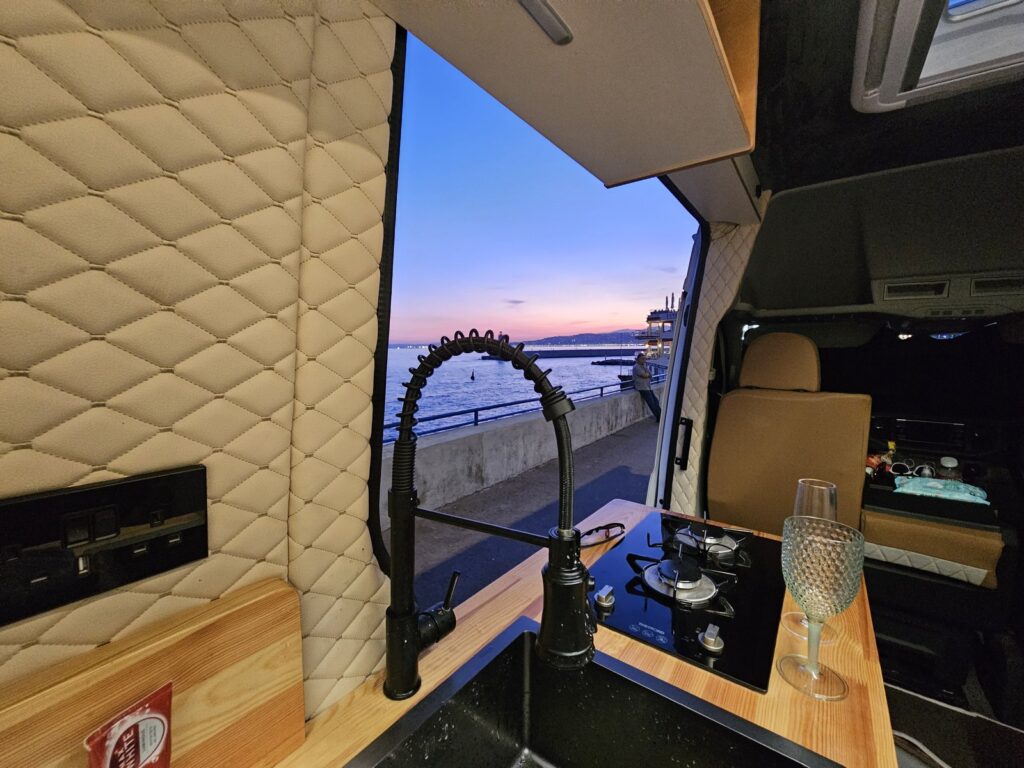 Sunset from the Crafter’s open galley on the coast at Nice.
Hook-up, fuel, money and roaming
Most hook-up posts use the blue CEE 17 230-volt 16-amp connector, the same shape you see on many UK sites. Some older French sockets differ, so a travel adaptor earns its keep. Reverse polarity turns up often enough that a polarity tester, and a proper reversing lead, belong in the drawer. See our guide to campervan electrics, hook-up and polarity.
Diesel, petrol and AdBlue are widely available at filling stations. If you are new to AdBlue, read AdBlue and DPF deletes explained before anyone offers a workaround that will fail an emissions check. Pay in euros. If you carry 10,000 euros or more in cash or the equivalent, you must declare it. Cards work in most places, but some aires still prefer cash.
“Roam like at home” is no longer a legal right for UK mobile customers in the EU. Ofcom says your provider must publish roaming charges and send a message when you arrive, unless you have opted out. It must also honour a bill limit if you set one. Check your own network before you go. Turn data roaming off if you are unsure, and download maps on Wi-Fi. Be careful on a ferry, because a satellite link can cost more than a land network. A travel eSIM is one way to keep data predictable.
Drive on the right. Keep to local speed limits. The alcohol limit is often lower than in England and Wales. You cannot take meat, milk or products that contain them into the EU, with limited exceptions for baby and medical food.
Can I get in trouble if the van is overweight?
Yes. Police and inspection teams on the continent do stop and weigh campervans. An overloaded van can mean a fine, a forced unload, or the end of that day’s driving. The figure that matters is the maximum weight on your V5C, plus the axle limits, not how the conversion feels on a British B-road. Weigh the van before you pack the last crate of wine. Our guides to campervan payload and whether you need a special licence still apply when you go abroad. A bike rack also adds length and, on some ferries, a higher fare. See bike racks for the T5 and T6. If the logbook still says van rather than motor caravan, that can change insurance and some road rules. See campervan insurance and the DVLA motor caravan guide.
Printable prep checklist
| Item | Notes |
|---|---|
| Passport | Issued less than 10 years before arrival, valid at least 3 months after you leave Schengen |
| V5C or VE103 | Original logbook, or VE103 for a hired or leased van |
| Driving licence | Photocard is enough in the EU and Switzerland. IDP only if you have a paper or Crown Dependency licence |
| Insurance | Confirm European cover, not just third party. Green card not needed in the EU and the countries listed above |
| UK sticker | UK, not GB. Always in Spain, Cyprus and Malta. Not needed in Ireland |
| EES time | No pre-application. Allow longer at the border. Done in the UK at Dover, Folkestone and St Pancras |
| ETIAS | Not in force. Do not buy from unofficial sites |
| 90/180 days | Count the whole Schengen area. Ireland does not count |
| GHIC plus travel insurance | Free GHIC from the NHS. Insurance still needed for repatriation and private care |
| European breakdown cover | UK-only policies often stop at the Channel |
| Triangle, hi-vis, headlamp adjusters | Compulsory in France and expected in many other countries |
| Crit’Air, Umweltplakette, LEZ logins, V16 | Order or register on official sites only, in time for the post to arrive |
| Austrian or Swiss vignette | Official ASFINAG or e-vignette.ch only. Note the 18-day wait on some Austrian digital vignettes |
| Ferry or LeShuttle booking | Quote the true height and length, pop-top down, racks included |
| Gas plan | Refillable tank with the right adaptor, or Campingaz. Do not count on exchanging Calor |
| Hook-up kit | Blue CEE lead, polarity tester, travel adaptor |
| AdBlue and fuel | Top up before long, empty stretches. No meat or milk in the fridge for the crossing into the EU |
| Phone roaming | Check your network, set a bill cap, download maps |
| Pets | Animal Health Certificate, microchip, rabies jab and timing rules |
| Weight | Weigh the packed van. Stay within the V5C and axle limits |
Frequently asked questions
What do I need to take a campervan to Europe?
A valid passport, the V5C or VE103, a UK licence, insurance that covers the trip, a UK sticker in most cases, and the country kit in the table above. Stay inside 90 days in 180. Allow time for EES. Get a ferry quote for your van’s real height and length.
How much is the ferry or Eurotunnel with a campervan?
It depends on height, length, date and ticket type. Headline “from” prices are usually for cars. A camper over 1.85 metres, or a motorhome of 6 metres or more, costs more. We could not retrieve a live camper quote on 17 November 2026, so get one from the operator for your measurements.
Does a pop-top, roof box or bike rack change the fare?
Yes, if it takes the van into a higher height band or adds length at the rear. Measure the vehicle as it will travel and book those figures.
Do I need ETIAS or a visa?
Not for a short Schengen visit on a UK passport today. ETIAS is not in operation. Do not buy it from any unofficial site. EES is already in force at the border and costs nothing.
How long can I stay in Europe in a campervan?
90 days in any 180-day period in the Schengen area as a whole. Days in Ireland do not count towards that limit.
Do I still need a green card or a GB sticker?
No green card is needed in the EU and the nearby countries listed by GOV.UK, though you still need insurance. Use a UK sticker, not GB. Spain, Cyprus and Malta always want the sticker.
Is a breathalyser still required in France?
No. Official French guidance, verified on 2 November 2026, says it is not obligatory. A triangle and a hi-vis vest are obligatory. Radar detectors are banned.
Is a V16 beacon mandatory in Spain for a UK van?
From 1 January 2026, a connected V16 is the only legal warning device for Spanish-registered vehicles. Official DGT guidance still allows foreign vehicles in international circulation to use warning triangles. A UK-approved triangle remains acceptable on that basis, and a connected V16 is still a practical extra.
Do I need a Crit’Air sticker?
Yes, if you will drive or park in a French ZFE, or during some pollution restrictions. Order it only from certificat-air.gouv.fr, currently 5.11 euros for a UK vehicle, and allow about 10 working days.
Can I take Calor gas, and can I wild camp?
You can take a Calor cylinder, but you will struggle to exchange it on the continent. A refillable tank or Campingaz is the practical plan. Wild camping is tightly limited. In France you may sleep in a legally parked van, but putting out chairs or an awning is usually treated as camping. Use aires and sites, and follow local signs.
Do I need an Animal Health Certificate for my dog?
Yes, if you live in Great Britain and take a dog, cat or ferret to the EU. Since 22 April 2026 you should not rely on an EU pet passport issued to a GB resident. The certificate is valid for 10 days to enter the EU, then up to 6 months for onward travel and the return to Great Britain.
Bottom line
Taking a campervan to Europe is still a brilliant way to travel. It is no longer a case of throwing a triangle in the cupboard and hoping for the best. Measure the van, quote the ferry honestly, order the official stickers in time, and watch the 90-day clock. EES is here. ETIAS is not, whatever a sponsored advert says. Do the paperwork once, then enjoy the aires. Dubbed Out Festival tickets go on sale on 31 January 2027, via Ticket Tent. For a heads-up when the early release opens, join the email list at dubbedoutfestival.co.uk, or come and compare crossing stories in the Facebook community.
