

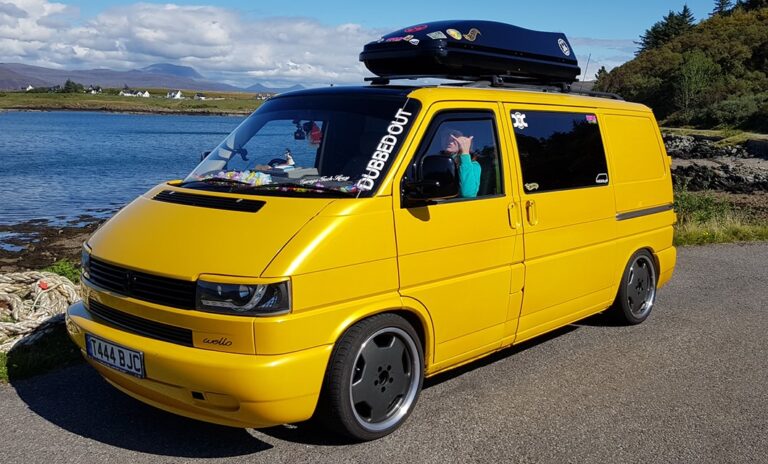
The Volkswagen T4 Transporter is still one of the vans people get most excited about buying. It was built from 1990 to 2003, followed the rear-engined T3 and was replaced by the T5, and it was the first VW van with a water-cooled engine up front and drive to the front wheels. That change freed up a proper space in the back, which is a big reason so many T4s have ended up as campers as well as work vans.
If you are looking at one, this guide covers which engine to go for, the difference between a panel van, a minibus, a pickup and a camper, what to check when you view one, and the paperwork that matters if it has already been converted.

VW T4 at a glance
| Years | 1990-2003 |
|---|---|
| Comes after / before | T3 / T5 |
| Layout | Front engine, front-wheel drive, with Syncro four-wheel drive as an option |
| Sizes | Short or long wheelbase, standard or high roof |
| Body styles | Panel van, Kombi, Caravelle or minibus, pickup and camper |
There was a facelift in 1996. The most obvious change is the longer front end, brought in so the VR6 petrol engine would fit, though you will also see that longer nose on some later campers and passenger models. Commercial vans often kept the shorter nose until the end of production.

T4 engines: which one to look for.
The T4 had a wide engine range, and the old lists you sometimes see online mix petrol and diesel up. Here is the line-up in plain English, with power figures in PS.
Petrol: a 1.8 (67PS, only from 1990 to 1992), a 2.0 (84PS, offered right through), a 2.5 five-cylinder (110PS, then 115PS from 1997) and the 2.8 VR6 (140PS from 1996, then a 204PS 24-valve version from 2000).
Diesel: a naturally aspirated 1.9 (61PS), a 1.9 turbo-diesel (68PS), a naturally aspirated 2.4 five-cylinder (78PS, later 75PS) and the 2.5 TDI in 88PS, 102PS and 151PS forms. The 102PS 2.5 TDI arrived in 1995 and is the one you will see most often.
If you want a starting point, look for the 2.5 TDI. Parkers calls it the best-performing of the standard engines, and it is the diesel most buyers go after. The 1.9 turbo-diesel is a simpler alternative that will not feel as brisk, but it is still a popular, tunable engine. The non-turbo diesels and the smaller petrols have to work a lot harder, and the VR6 can be a lovely thing if it has been serviced properly, though it is thirsty and needs looking after.
Most T4 engines are fundamentally tough if they have been maintained. A service history matters more than a modest mileage on its own, and later, post-1996 vans are generally thought of as the better-built ones.
Panel van, minibus, pickup or camper?
T4s came in several shapes, and the right one depends on how you want to use it.
- Panel van: the working van, with a single row of seats and no windows behind the cab (or only what a later conversion has added). Short and long wheelbase, and a high roof was available on the long wheelbase. A good starting point if you want to convert one yourself, provided the shell is sound.
- Kombi: sometimes called a half-panel. Extra windows and a second row of seats, so it sits between a panel van and a full people-carrier.
- Minibus or Caravelle: the passenger versions, with windows all round. Seat counts vary. A short-wheelbase Caravelle could take up to nine people, and the long wheelbase had room for more, so do not assume every people-carrier is an eight- or nine-seater. Check how many belted seats it actually has.
- Pickup: a flatbed, in single-cab (short wheelbase) or double-cab form. Great as a work or weekend utility, less obvious as a camper unless you have a very particular plan for the bed.
- Camper: anything from a factory Westfalia California (sold by Volkswagen, and quite rare) to a professional conversion or a self-build. This is where a lot of T4s end up, and it is also where you need to look hardest at how the work was done.


VW T4 review: what owners like and what to watch.
People still buy T4s because they work. Compared with the T3, it is a much more car-like van to drive, with a proper front cab and a useful load space. There is a huge amount of knowledge out there, specialists who know these vans inside out, and a decent supply of mechanical parts, which is a comfort when you are buying something that is now more than 20 years old. It is also, for the moment, one of the more affordable ways into a VW camper.
The main thing to watch is rust. On a van this age, especially one that started life as a commercial, corrosion is the usual deal-breaker, not a dramatic engine failure. Common places include the base of the windscreen, the wheel arches, the sills, the bottom of the sliding door, the area around the fuel filler, the rear crossmember by the rear springs, and as much of the underside, floor and inner wings as you can see. A fresh coat of underseal or a wrap is not automatically a problem, but it can hide a lot, so look closely.
On the mechanical side, the issue you are most likely to hit is overheating from a lack of coolant, which can lead to a failed head gasket or a warped cylinder head. The 2.4 diesel in particular has a reputation for head gasket trouble, and Parkers flags the fuel pump on the 1.9 turbo-diesel as a weak spot. On the 2.5 TDI, the cambelt also drives the water pump, so a belt and pump change at the right time is not a job to skip. The VR6 needs a proper service history. Manual gearboxes are generally robust, though synchromesh can wear, and a crunch into gear is sometimes just tired oil rather than a dead box.
If the van is already a camper, the conversion is as important as the vehicle. A tidy interior can hide rushed joinery, poor electrics or a leaky pop-top. Professional conversions are usually the safer bet, but a careful self-build can be perfectly good if you can see that it has been done properly.
What to check on a viewing.
Before you set off, run the registration through the free GOV.UK MOT history check. You will see past pass and fail results, the mileage recorded at each test, what failed or was advisory, and when the next MOT is due. It is one of the most useful things you can do in five minutes, and it costs nothing. T4s predate AdBlue, so if you are comparing a later diesel, read our AdBlue and DPF guide.
When you get there, give yourself time and take a torch. Have a good look at the rust spots above, including underneath, and be wary of fresh underseal or filler with no explanation. Check that the sliding door runs smoothly and sits flush, and lift it slightly to feel for play in the top rail. If there is a pop-top or a high roof, inspect the seals outside and look for damp or staining inside.
Try to see the engine from cold if you can. Check for oil, coolant or fuel leaks, look at the coolant in the expansion tank, and watch the temperature once it is up to running heat. Ask when the cambelt and water pump were last done, and look for bills. If there is no proof of recent work, budget for that before you rely on the van. On a test drive, listen for knocks from the suspension, make sure it stops in a straight line and that the gearbox does not jump out of gear.
If it is a conversion, try the leisure electrics, switches and sockets, and any water or gas points. Look for damp in the upholstery, and check how the bed, seatbelts and furniture are actually fixed down, not just how they look. On a former panel van, look carefully at how any windows have been cut in, because poorly treated edges can rust out of sight. And check the VIN plate for the weights on that particular van, because payloads vary and it is easy to use up the allowance once a camper interior, passengers and kit are on board.
Conversions and paperwork.
A converted T4 can be a brilliant buy, but the paperwork needs to match what the van actually is. If you want it registered as a motor caravan rather than a commercial van, that is a DVLA process, not just a matter of putting a bed in the back. We have a separate guide to getting a van reclassified as a motor caravan, including what the DVLA looks for with a pop-top.
Insurance is the other big one. A self-build is not treated the same as a factory or professional motor caravan, and the wrong policy can catch you out. Our guide to campervan insurance in the UK talks through that in plain English.
Ask to see the V5C, any conversion invoices, gas and electrical certificates if they exist, and the service history. If the seller cannot show you how the work was done, treat that as a reason to slow down, not a detail to tidy up later.
Kitting out your T4.
Once you have a sound van, the fun bit is making it yours. Plenty of T4s end up on different wheels, with a bit of lowering or a bike rack on the back, and none of that is unusual. Just buy on the condition of the van first. Lowered suspension and bigger wheels can spoil the ride if they have been done badly, and any aftermarket wheels need to be properly load-rated for a van, especially once a camper interior is in it.
Our guides to wheels, tyres, suspension and lift kits and to bike racks were written for the T5 and T6, so the fittings are not the same. If you move on to a later Transporter, or you just want a sense of how people kit a VW van, they are still useful reading.
What a T4 costs now.
Prices vary wildly with condition, rust, engine, mileage, and whether you are looking at a plain panel van, a tired self-build or a well-kept professional camper. A shiny advert is not the same as what a van is actually worth, so look at the shell and the history first, then the furniture.
Writing in August 2025, Parkers put a basic van that still needed work before conversion at under £3,000, a camper that needed some tidying at around £5,000, a usable camper at £10,000 to £15,000, and a high-quality camper or motorhome at more than £15,000. They suggested around £20,000 for a factory Westfalia California, and said some ads above £25,000 looked a bit ambitious. Those figures will have moved since, so use them as a feel for the spread rather than a price list. For a wider look at what buying and running a first camper can involve, we also have a guide to the cost of buying your first campervan.
Owning a T4 is about more than the van itself. It is about joining a community of people who use theirs, tinker with them and bring them out to meets. You will see plenty in our gallery too.
T4s are always out in force at Dubbed Out Festival. The Sunday show and shine is always free, open to all makes and models, and the entrance is Gate 2, Flittogate Ln, Tabley, Knutsford WA16 0HJ. Dubbed Out 2027 is at the Royal Cheshire Showground, Knutsford, from 29 July to 1 August 2027. Tickets go on sale through Ticket Tent on 31 January 2027, with early access for newsletter sign-ups. Pop your email in at dubbedoutfestival.co.uk to be told first when they go on sale.
If you want a bit of Dubbed Out on the van once it is yours. Our windscreen sticker comes with free UK postage. Or have a look at the rest of the Dubbed Out stickers.
