

Campervan vs Tent Camping: The Great British Camping Showdown
Two ways to enjoy the great outdoors. One comes with a mattress, a fridge and possibly a toilet. The other comes with a zip that jams when you’re desperate for a wee.
Ah, camping. Fresh air, beautiful scenery, spectacular sunsets and the opportunity to spend an entire weekend arguing about where somebody put the bottle opener.
But before you head into the countryside, there’s one important decision to make.
Campervan or tent?
On one side, you’ve got the campervan owners. They’ve brought a proper bed, a fridge, a kettle, enough fairy lights to illuminate Blackpool and a collection of camping accessories worth more than your first car.
On the other side, you’ve got the tent campers. They’ve brought a lightweight shelter, a sleeping bag, a camping stove and the sort of optimism normally associated with people buying lottery tickets.
Both insist they’re doing camping properly.
Both think the other lot have completely lost the plot.
And both will spend at least part of the weekend standing outside in the rain, holding a beer and insisting they’re having a fantastic time.
So, which really is better?
Let’s settle this properly, from the cost of getting started to the joys of festival camping, wild adventures, midnight toilet emergencies and the Great British Weather.
Campervan vs Tent: The Quick Comparison
| Category | Campervan | Tent | Winner |
|---|---|---|---|
| Initial cost | Potentially very expensive | Usually much cheaper | Tent |
| Running costs | Insurance, servicing, repairs and more | Generally minimal | Tent |
| Sleeping comfort | Often a proper mattress | Depends on your camping bed | Campervan |
| Packing capacity | Fridge, chairs, clothing and plenty of kit | Limited by what you can transport | Campervan |
| Remote backpacking | Restricted to vehicle access | Lightweight tents can go much further | Tent |
| Bad weather | Solid walls and somewhere dry to sit | Depends on the tent and conditions | Campervan |
| Spontaneous trips | Convenient when already packed | Requires more setup | Campervan |
| Festival comfort | More storage and shelter | Simpler and often cheaper | Campervan |
| Portability | You need somewhere to drive and park | Can be carried on foot | Tent |
| Toilet emergencies | Possible onboard facilities | Campsite toilet or other permitted arrangements | Campervan, if equipped |
Early verdict: Campervans are winning on comfort. Tents are winning on affordability and adventure.
But we’re only getting started.
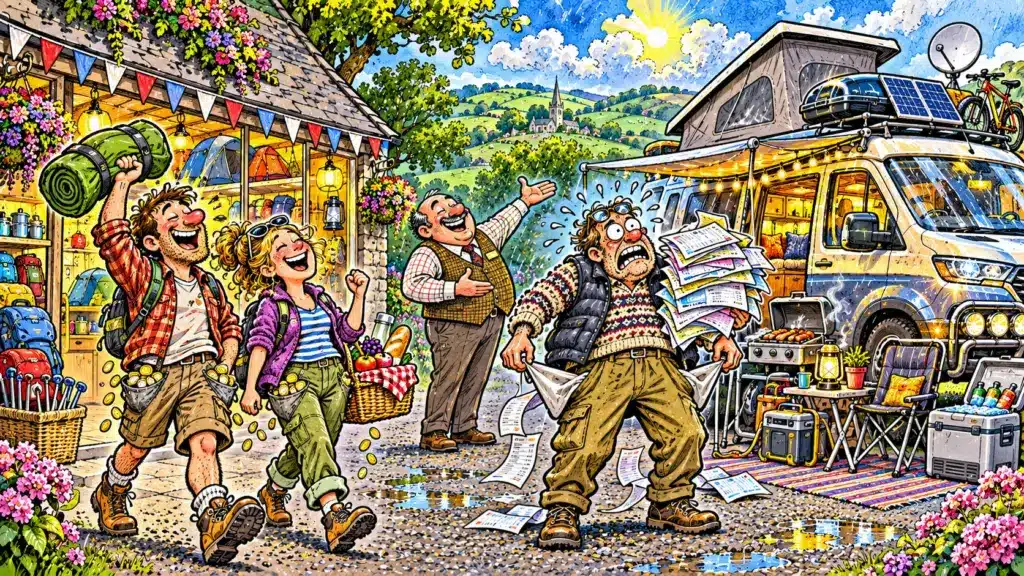
1. The Cost: £100 Tent vs £50,000 Campervan
Let’s begin with the question that causes the biggest argument.
Is tent camping cheaper than owning a campervan?
Yes. In most cases, considerably.
A basic tent can cost relatively little, although a good family tent, sleeping mats, decent sleeping bags and all the associated equipment can quickly add up.
A campervan, meanwhile, can cost anything from a relatively modest amount for an older conversion to tens of thousands of pounds for a newer, fully equipped model.
And that’s before you’ve bought the accessories.
Because nobody simply buys a campervan.
First comes the van.
Then the awning.
Then the camping chairs.
Then the solar panel.
Then the lithium battery.
Then the £300 coffee machine because apparently instant coffee is no longer acceptable once you’ve got a pop-top roof.
Before you know it, you’ve spent enough money to buy a small bungalow, all so you can sleep in a field and eat bacon sandwiches.
What does a campervan actually cost to run?
Depending on the vehicle and how you use it, you may need to budget for:
- Insurance
- Vehicle tax, where applicable
- MOT testing
- Servicing and repairs
- Tyres and fuel
- Storage, if you cannot keep it at home
- Replacement batteries and camping equipment
- Depreciation
A tent doesn’t need an MOT.
It doesn’t need insurance to drive it.
And nobody has ever received a £1,200 garage bill because their tent’s turbocharger has failed.
Although if you’ve ever tried replacing the poles on a complicated family tent, you’ll know that camping equipment can still find creative ways to empty your wallet.
Winner: Tent camping.
By a country mile.
But cost isn’t the only consideration. If you use your campervan frequently, enjoy road trips and value having your accommodation ready to go, the convenience may justify the expense.
Just don’t try explaining that to your accountant.

2. Sleeping: Proper Mattress or Inflatable Instrument of Torture?
This is where campervans start fighting back.
Picture the scene.
It’s 11pm.
The campervan owner climbs into a comfortable bed, pulls up the duvet and settles down for a decent night’s sleep.
Across the field, the tent camper is discovering that their inflatable mattress has developed a slow puncture.
At midnight, they’re comfortable.
At 2am, they’re slightly closer to the ground.
By 5am, they’re effectively sleeping on a collection of rocks with a thin layer of plastic between them and the Earth’s crust.
Of course, modern camping equipment can be excellent. A quality sleeping mat, suitable sleeping bag and properly pitched tent can provide a genuinely comfortable night’s sleep.
And not every campervan has a luxurious bed. Some conversions require a nightly furniture-moving operation that resembles assembling a wardrobe in the dark.
But for most people, a well-equipped campervan has the advantage.
Winner: Campervan.
Particularly for anyone whose knees now make noises when they stand up.
3. The Great British Weather: Five Minutes of Sunshine
There’s nothing quite like the British weather.
And nobody appreciates it more than campers.
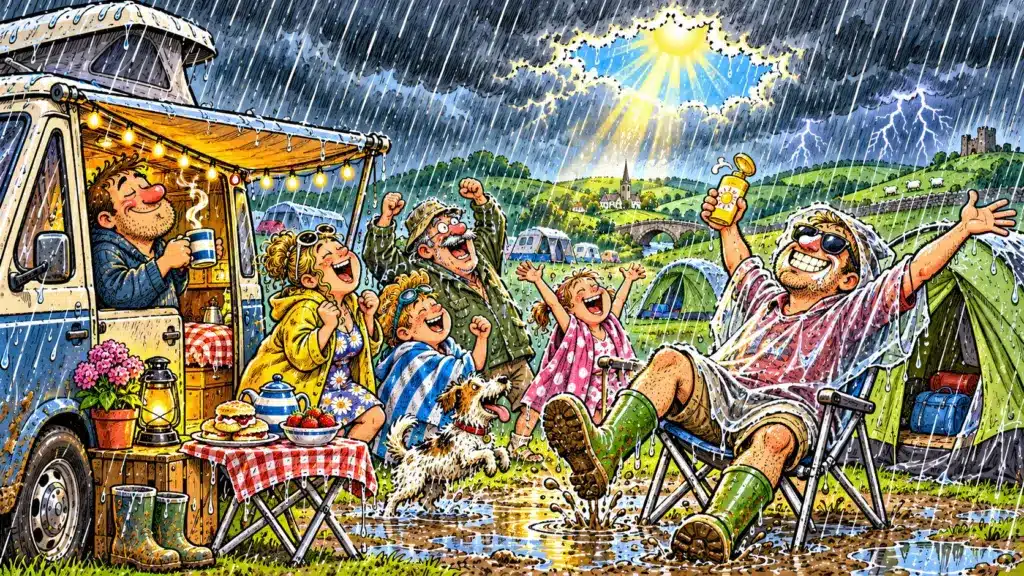
It’s been raining for eleven hours.
The awning resembles a paddling pool.
Somebody’s gazebo has been spotted heading towards Wales.
The camping chairs are wetter than an otter’s pocket.
Then suddenly, the rain stops.
THE RAIN HAS STOPPED!
Within thirty seconds, everyone emerges from their accommodation.
Barbecues are lit.
Beers are opened.
Someone puts on shorts.
And Dave announces, with absolute confidence:
“I reckon it’s brightening up!”
Four minutes later, the heavens open again.
Dave refuses to move.
“It’s only a shower,” he insists, as his burger floats past his ankles.
Is a campervan warmer and drier than a tent?
Generally, a properly insulated campervan provides better protection from wind and rain, especially if it has suitable heating.
But not all campervans are insulated or heated, and poorly ventilated vehicles can suffer condensation.
Likewise, a good-quality tent can remain dry in heavy rain when correctly pitched and maintained. Ventilation is important because moisture collecting inside a tent can look remarkably like a leak.
The difference is what happens when the weather turns truly miserable.
The campervan owner can usually close the door and sit somewhere comfortable.
The tent camper can also stay dry, but may have considerably less space to move around.
And when you’ve spent three hours sitting cross-legged in a tent, even putting your socks on becomes an Olympic event.
Winner: Campervan.
Although British weather has a remarkable ability to make everyone miserable eventually.

4. Wild Camping: Where Tents Fight Back
Now here’s something that might surprise a few campervan owners.
Tents can offer access to camping experiences that campervans simply cannot.
Imagine walking into the Scottish Highlands with a lightweight tent, finding a beautiful permitted spot and spending the evening surrounded by mountains.
No engines.
No traffic.
No neighbouring campervan running its diesel heater.
Just fresh air, wildlife and the occasional midgie attempting to remove your face.
A campervan cannot follow you everywhere.
And crucially, the rules are different.

Can you wild camp anywhere in the UK?
No.
In Scotland, responsible lightweight wild camping is generally permitted under Scottish outdoor access rights, subject to the Scottish Outdoor Access Code and local restrictions.
Those access rights do not extend to motor vehicles.
In England and Wales, camping generally requires the landowner’s permission unless specific rights or arrangements apply.
Dartmoor is a notable exception for backpack camping in designated areas, but its rules specifically exclude overnight stays in campervans and motorhomes.
So, buying a £70,000 campervan doesn’t automatically give you the right to park beside every beautiful loch, lake or mountain.
Apparently, the Scottish Highlands aren’t included in the finance agreement.
For genuine remote backpacking, lightweight tents have a clear advantage.
Winner: Tent camping.
And a well-deserved one.
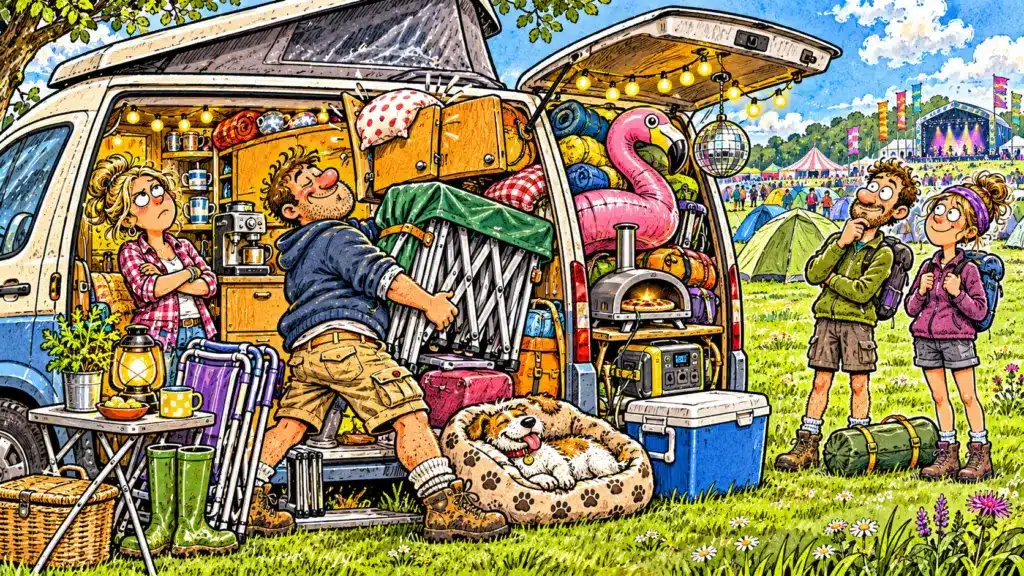
5. Packing: Everything Including the Kitchen Sink
Tent camping requires a certain amount of discipline.
You need to think about what you’re taking, how much it weighs and whether you can actually transport it.
Campervan camping operates under a slightly different philosophy.
If it fits, it comes.
Extra chairs?
Of course.
A barbecue?
Naturally.
Three different jackets?
Well, this is Britain.
A portable pizza oven?
Why not?
An inflatable flamingo?
Essential.
A second fridge because the first one is full of beer?
Now we’re talking.
The beauty of a campervan is that much of your equipment can stay packed between trips.
You can finish work on Friday, grab some food and head away for the weekend without spending three hours trying to remember which cupboard contains the tent pegs.
Of course, vehicle weight limits still apply, and carrying half your house isn’t necessarily a good idea.
But the convenience is undeniable.
Winner: Campervan.
Especially if your idea of travelling light involves leaving the air fryer at home.
Part Two: Campervan vs Tent at a Festival
This is where things get really interesting.
Because ordinary camping is one thing.
Festival camping is an entirely different species of madness.
Thousands of people arrive in a field with music, camping equipment, questionable fancy dress and enough alcohol to concern a small European nation.
Some arrive in campervans.
Some arrive with tents.
And everyone is convinced they’ve made the correct decision.
Let’s see how they get on.
6. Arriving at the Festival
The tent camper arrives.
They park, unload their equipment and begin searching for the perfect pitch.
Not too close to the toilets.
Not too far from the toilets.
Not next to the generator.
Not at the bottom of a hill.
Not beside the group who have already started singing Sweet Caroline at eleven in the morning.
Eventually, they find somewhere suitable.
Now they have to put the tent up.
The instructions are missing.
One pole is mysteriously shorter than the others.
The wind has picked up.
And somebody has just announced that they’ve left the mallet at home.
Meanwhile, the campervan owner arrives, parks and opens a beer.
Smugness levels are dangerously high.
But let’s be fair.
Campervans aren’t always easy to pitch either.
There’s always one bloke who spends forty minutes reversing a Transporter into a space big enough to land a Boeing 747.
His wife is standing behind the van waving her arms.
He’s ignoring her.
The entire campsite is watching.
And somehow, he’s still managed to park on the electric hook-up cable.
Winner: Campervan, usually.
Provided the driver can reverse.
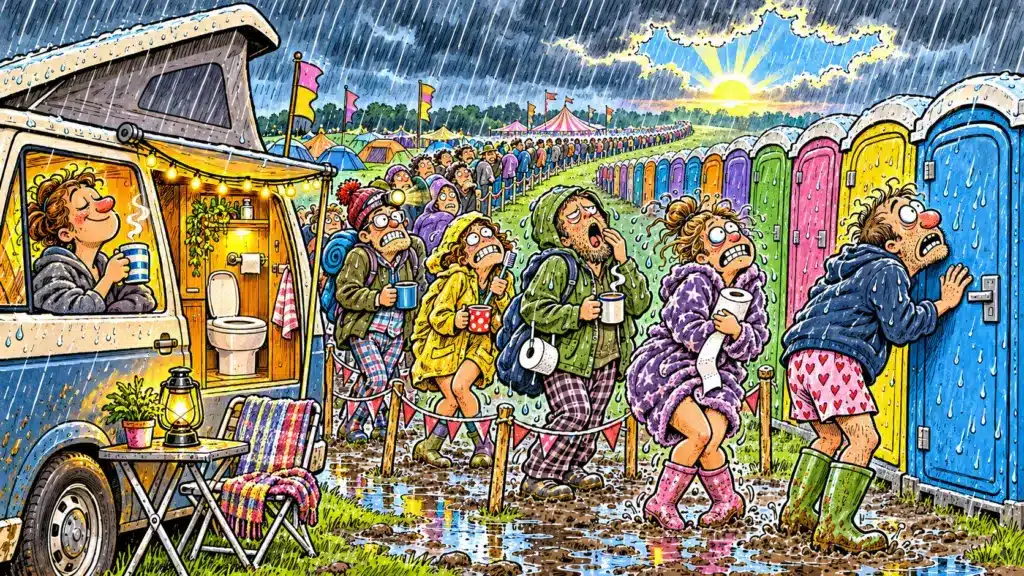
7. Festival Toilets: The Ultimate Test of Character
There are few experiences more memorable than a festival toilet at three in the morning.
You wake up.
You need a wee.
Quite urgently.
You lie there for a moment, wondering whether you can make it until morning.
You cannot.
For the tent camper, this means finding your shoes, locating your torch and negotiating the tent zip without waking everyone.
Then comes the walk.
Across a dark field.
Through wet grass.
Past somebody’s inflatable unicorn.
Towards a toilet block that sounds suspiciously like a nightclub.
You finally arrive.
There’s no toilet roll.
Of course there isn’t.
Do campervans have toilets?
Some do.
Many smaller campervans don’t.
Others carry portable toilets, which can be useful for overnight emergencies.
And let’s not pretend that emptying a portable toilet is anybody’s favourite holiday activity.
There’s something deeply humbling about standing at a chemical disposal point, holding a container full of your family’s worst decisions.
But when it’s cold, raining and three in the morning, having your own properly maintained toilet can feel like the height of luxury.
Winner: Campervan, if it has a toilet.
Otherwise, congratulations. You’re joining the same queue as everyone else.
8. The 5am Dog-Poo Expedition
Camping with dogs is wonderful.
Fresh air.
Long walks.
New smells.
Beautiful countryside.
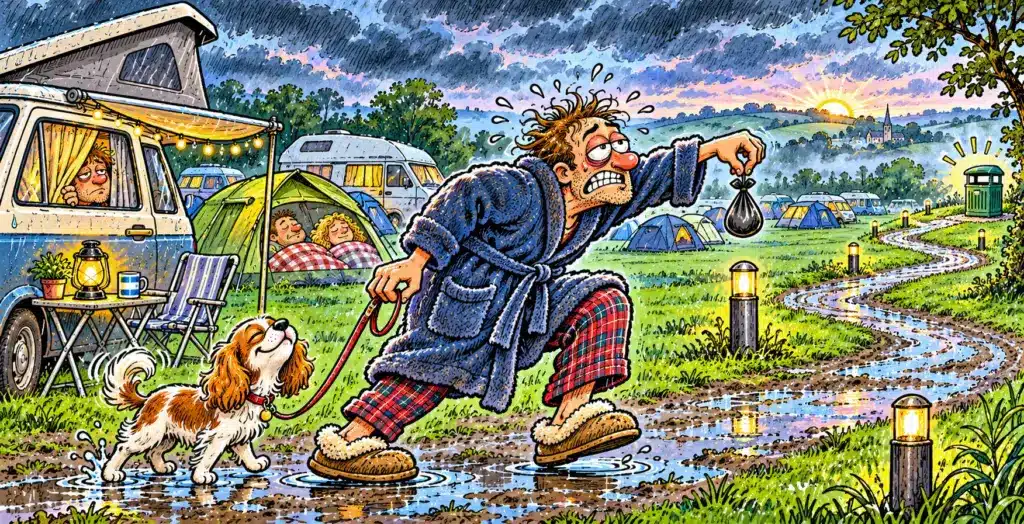
And the opportunity to wander around a campsite at five in the morning carrying a warm bag of dog shit.
There you are.
Still half asleep.
Wearing pyjama bottoms, Crocs and a jacket you found on the floor.
The birds are singing.
The sun is rising.
The countryside looks magnificent.
And you’re desperately searching for a bin while holding what can only be described as a small, steaming parcel of Labrador evidence.
Meanwhile, your dog is absolutely delighted with itself.
By the time you get back, it’s curled up in your sleeping bag.
Fast asleep.
Having the time of its bloody life.
This is one camping experience that unites tent campers and campervan owners.
Winner: The dog.
Every single time.
And remember: bagged dog waste belongs in an appropriate bin or must be taken away with you. Leaving the bag hanging from a tree isn’t an acceptable alternative.
9. The Sliding Door of Suspicion
There’s no alarm clock quite like a VW Transporter sliding door.
CLUNK. RUMBLE. BANG!
It’s six in the morning.
You’ve finally fallen asleep after a brilliant night of festival entertainment.
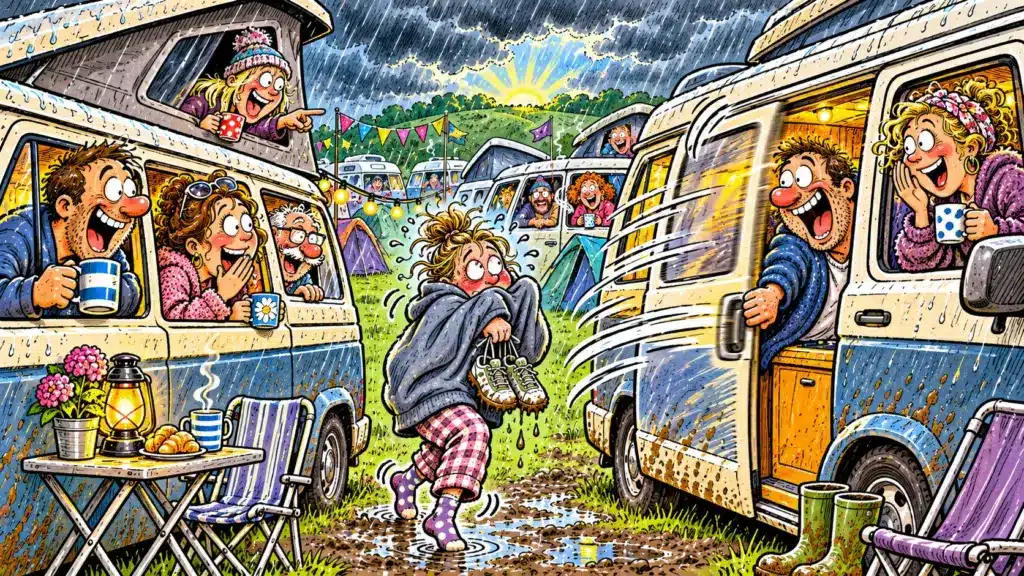
Then somebody opens a sliding door.
You wake up immediately.
Your first thought is murder.
Your second thought is wondering why anybody needs to make that much noise just to get out of a vehicle.
You peer through the curtains.
And there, moving suspiciously quickly across the grass, is your next-door neighbour.
They’re emerging from a campervan three pitches down.
Carrying their shoes.
In their socks.
Trying desperately not to be noticed.
Wrong van?
Secret romance?
Just borrowing some milk?
Nobody knows.
But judging by the speed they’re moving, we’re guessing it wasn’t a plumbing emergency.
Naturally, by breakfast, the entire campsite knows.
What happens on the campsite stays on the campsite. Unless somebody owns a VW with a sliding door.
Tent campers have their own noise problems, of course.
Zips.
Snoring.
Rustling sleeping bags.
And that one person who insists on having a full-volume conversation outside your tent at 4am.
Winner: Nobody.
We’re all awake now.
10. Festival Comfort: The Afternoon Recovery Session
Festivals are exhausting.
You spend the day walking around, watching entertainment, eating things you probably shouldn’t and promising yourself you’ll have an early night.
You won’t.
By Saturday afternoon, everyone needs a little recovery time.
The campervan owner returns to their pitch.
They make a brew.
Put their feet up.
Open the fridge.
Perhaps even have a little lie-down.
The tent camper also returns to their pitch.
They sit in a camping chair.
The chair sinks into the grass.
Their drink falls over.
A wasp arrives.
Then another wasp.
Then Dave appears and asks whether anyone’s seen his sunglasses.
They’re on his head.
Naturally.
But tents have one big advantage here: they can provide a perfectly good festival base without the expense of owning a vehicle.
And at events where tent camping is cheaper, the savings can be substantial.
Always compare the actual festival ticket and pitch arrangements, because rules vary.
Winner: Campervan for comfort. Tent for affordability.
11. Festival Packing: Who Brings the Most Ridiculous Equipment?
Festival campers have a remarkable ability to convince themselves that absolutely everything is essential.
The tent camper packs:
A tent.
Sleeping bag.
Camping chair.
Cool box.
Clothes.
Toiletries.
And enough snacks to survive a minor national emergency.
The campervan owner packs all of that.
Plus a gazebo.
A barbecue.
A second fridge.
A television.
A portable speaker.
Sixteen cushions.
A decorative rug.
Three different sets of fairy lights.
And a folding table that requires an engineering qualification to assemble.
By Friday afternoon, their pitch looks like a branch of IKEA has opened in a field.
By Sunday, they’re trying to remember how it all fitted inside the van.
Winner: Campervan for carrying capacity.
Winner: Tent for not needing a second mortgage to buy the accessories.

12. The Festival Atmosphere: Does Your Accommodation Really Matter?
Here’s where the competition becomes a draw.
Because whether you’re sleeping in a tent or a campervan, the best part of a festival isn’t your accommodation.
It’s the people.
The entertainment.
The atmosphere.
The friends you arrive with and the new ones you make.
It’s sitting outside on a warm evening, listening to music and laughing at stories that somehow get funnier every time they’re told.
It’s watching the children have the time of their lives.
It’s seeing dogs make new friends.
It’s the ridiculous fancy dress.
The spontaneous dancing.
The neighbour who lends you a bottle opener.
And the complete stranger who becomes your best mate for the weekend.
At Dubbed Out Festival, we’ve seen just how much these shared experiences mean to families, friends and campervan enthusiasts.
And although we obviously love a good campervan, the real magic isn’t what you sleep in.
It’s what happens outside it.
Winner: Everyone who turns up ready to enjoy themselves.
Frequently Asked Questions About Campervan vs Tent Camping
Is camping in a tent cheaper than a campervan?
Usually, yes. Tents generally have a much lower purchase price and fewer ongoing costs. Campervans involve vehicle-related expenses such as insurance, servicing, fuel and repairs.
Is a campervan better for families?
A campervan can make family camping more convenient because it provides storage, shelter and often more comfortable sleeping arrangements. However, a spacious family tent can also work brilliantly, particularly for families camping on a budget.
Can you sleep in a campervan anywhere in the UK?
No. Overnight parking and sleeping restrictions depend on the location, land ownership, signage and applicable rules. You should check before staying overnight.
Is wild camping legal in Scotland?
Responsible lightweight wild camping is generally permitted under Scottish outdoor access rights, subject to the Scottish Outdoor Access Code and local restrictions. Those rights do not extend to motor vehicles.
Can you cook inside a tent?
You should not use camping stoves or barbecues inside an ordinary tent or awning. Carbon monoxide poisoning and fire are serious risks. Follow the equipment manufacturer’s instructions and recognised camping safety guidance.
Which is better for a music festival, a tent or a campervan?
Campervans generally offer more comfort, storage and shelter. Tents are usually more affordable and simpler to transport. Check the festival’s camping rules and pitch prices before deciding.
Do you need a toilet in a campervan?
No, not every campervan has one. But an onboard or portable toilet can be very convenient, particularly at night or when staying somewhere with limited facilities. Waste must be disposed of at appropriate facilities.
Is a campervan worth buying?
That depends on your budget, how often you travel and how much you value convenience. If you only camp once or twice a year, a tent may make better financial sense. If you enjoy frequent road trips and weekends away, a campervan may be worth the additional cost.
The Final Verdict: Campervan or Tent?
After extensive consideration, detailed comparisons and several completely unnecessary toilet jokes, we’ve reached a conclusion.
Tents are brilliant.
They’re affordable, portable and capable of taking you on adventures that campervans simply cannot.
There’s something wonderful about packing everything you need into a rucksack and heading into the countryside.
And if you’re new to camping, a tent is often the easiest way to get started.
But campervans?
Well, campervans are rather special too.
There’s the comfort.
The convenience.
The freedom of the open road.
The ability to carry everything you need.
And the sheer joy of sitting inside with a hot cup of tea while the rain lashes against the windows.
Yes, they cost more.
Yes, they need maintaining.
And yes, VW sliding doors should probably come with a noise pollution warning.
But once you’ve experienced the convenience of having your own little home on wheels, it’s difficult to go back.
Our official Dubbed Out verdict
For budget camping and remote adventures: Tent.
For comfort, convenience and festival weekends: Campervan.
For having an absolutely brilliant time with your mates: Either.
Because whether you’re sleeping in a £70,000 campervan or a £70 tent, we’re all doing fundamentally the same thing.
Paying good money to sit in a field, drink tea and complain about the weather.
The only difference is how far you have to walk for a wee.
Fancy a Festival Weekend of Your Own?
If you love campervans, camping, live entertainment and spending time with good people, we’d love you to discover Dubbed Out Festival.
It’s a celebration of campervan life, music, families, friendship and all the wonderfully ridiculous things that happen when thousands of camping enthusiasts get together.
Whether you’re a seasoned festival regular or planning your first big weekend away, come and see what all the fuss is about.
Explore Dubbed Out Festival, find out what’s planned and get ready for the next adventure at dubbedoutfestival.co.uk.
See you in the fields.
And don’t forget the toilet roll.
