


Campervan Beds Explained: Rock and Roll, RIB and Roof
Campervan beds explained, in plain English. In a Transporter-sized van, the bed is also the sofa, and often the rear seat on the move. Most Transporter-style vans you’ll see have a rock and roll or RIB bed. A pop-top roof bed is the usual extra berth. In a bigger van, such as a Crafter, a fixed rear bed is the more common alternative. This is an owner-to-owner look at those setups, who can sleep where, and what UK crash-tested seats mean. It is not a best-bed ranking. Sleeping space is not the same as a belted travel seat. You can also read it at https://dubbedout.co.uk/latest-news/campervan-beds-explained/.
 [Image: Official Volkswagen photo of the rear bench in a California 6.1, folded out as a bed, with the side door open]
What is a rock and roll bed, and how does it work?
A rock and roll bed is a rear bench that folds or slides flat. You sit on it by day and sleep on the same side of the cushions at night. That is the usual downstairs bed in a UK Transporter conversion, in 3/4 or full width. Factory Californias use a similar folding rear bench.
Comfort varies. Some sleep flat. Cheaper frames can leave a ridge at the hinge, a widely reported trade-off rather than a knock on named makers. Most Transporter-style vans you’ll see have a rock and roll or RIB bed. The bench often hides useful storage. See our campervan storage guide (https://dubbedout.co.uk/latest-news/campervan-storage-ideas/) at https://dubbedout.co.uk/latest-news/campervan-storage-ideas/. Measure the bed when you fold it flat, and count the belts, not just the cushions.
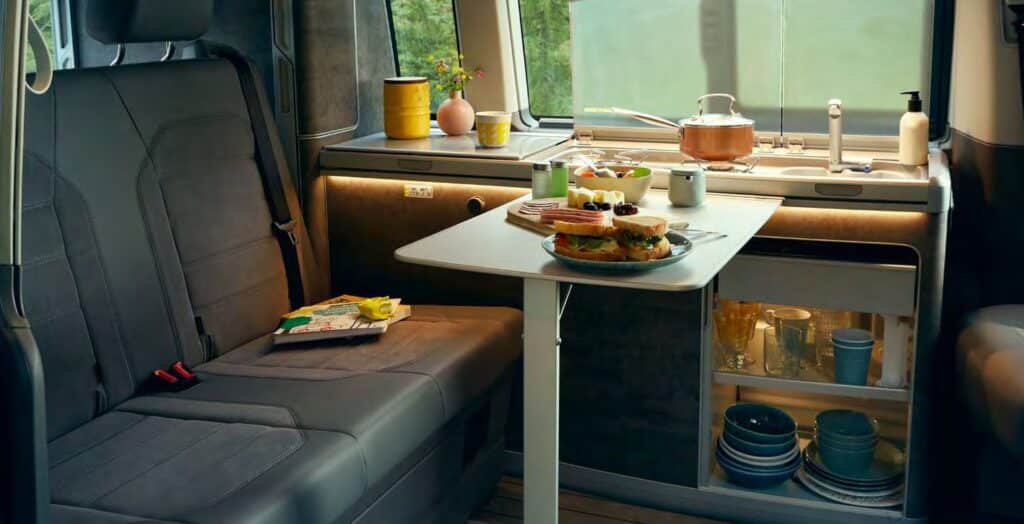 [Image: Official Volkswagen photo of the rear bench in a California 6.1, in seat mode beside the kitchen and table]
What is a RIB bed, and how is it different?
RIB is a brand of seat-bed made by Scopema in France, not a generic name for every crash-tested bench. The cushions flip, so you sit on one face and sleep on the other. People usually call that a flatter mattress. A rock and roll uses the same side for both. Both can have seat belts.
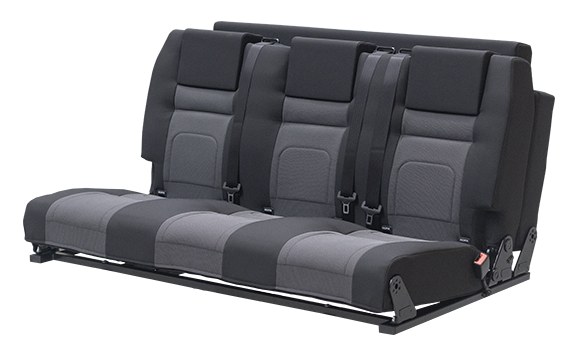 [Image: Official Scopema product photo of a three-seat Altair 3P RIB bench with integrated three-point seat belts]
Some rock and roll beds have a test certificate too, and some do not, so always ask. Official Altair 3P two-seat widths are 860, 940, 1,040, 1,120 and 1,200mm. Three-seat widths are 1,200, 1,290, 1,400 and 1,500mm. Sleeping length is 1,790, 1,860 or 1,940mm, depending on the second backrest. They have integrated three-point belts, and ISOFIX top tether on the relevant widths. Scopema also sells them on sliding or fixed rails. This is not a best-bed ranking.
Pop-top roof beds
A pop-top roof bed is the second sleeping space in many Transporters and factory Californias, once the roof is up. It adds a berth upstairs. It does not add two belted travel seats downstairs. Our pop-top conversion guide (https://dubbedout.co.uk/latest-news/pop-top-conversion-for-a-vw-transporter/) at https://dubbedout.co.uk/latest-news/pop-top-conversion-for-a-vw-transporter/ covers fitting a roof. This section is about the bed in it.
 [Image: Official Volkswagen photo of the pop-top roof bed in a California 6.1, with the canvas roof up and a mattress in place]
How many people can sleep up there, and in the van as a whole?
Most factory Californias sleep up to four, according to Volkswagen: two in the roof and two on the lower bench bed. That still depends on the exact trim. A simpler Beach layout may not have the same lower bed. Sleeping places are not the same as belted travel seats. Check the van.
See our used California buying guide (https://dubbedout.co.uk/latest-news/used-vw-california-buying-guide/) at https://dubbedout.co.uk/latest-news/used-vw-california-buying-guide/. Keep official figures with the right generation. The California 6.1 brochure says up to four sleeping spaces. The loft bed is about 2,000 x 1,200mm, with a sprung base, mattress and child safety net. The Beach Camper bench bed is about 2,000 x 1,500mm. The new California UK brochure lists a roof-top bed of 2,054 x 1,137mm, with a 200kg load capacity. The lower bed is 1,980 x 1,330mm on the Beach. On Coast and Ocean, the equipment list gives 1,980 x 1,080mm, also 200kg. Do not mix those generations.
Can you sleep in a pop-top in winter, or in the rain?
Yes, plenty of people do. A canvas roof is only a single layer, so it will be colder than the insulated body. Condensation likes the cold surface under the mattress. Use warm bedding, keep a little ventilation going, and dry the canvas before you pack the roof down.
Our damp and condensation guide (https://dubbedout.co.uk/latest-news/campervan-condensation-damp-leaks/) at https://dubbedout.co.uk/latest-news/campervan-condensation-damp-leaks/ covers the wider problem.
What is the weight limit on a roof bed?
It varies, so check the handbook or the roof maker. The one official figure we can quote is for the new California. Volkswagen’s UK brochure gives that roof-top bed a 200kg load capacity. That figure is for the new California only. Do not treat it as a limit for every T5, T6 or aftermarket pop-top.
Fixed beds in bigger vans
In a Crafter-sized van, the usual answer is a proper fixed rear bed, sometimes with a garage underneath. Our own vans are Crafters with fixed beds. A fixed bed needs no seat test. Do not use it as a seat while the van is moving. That is GOV.UK’s line, not a ranking of which bed is safer.
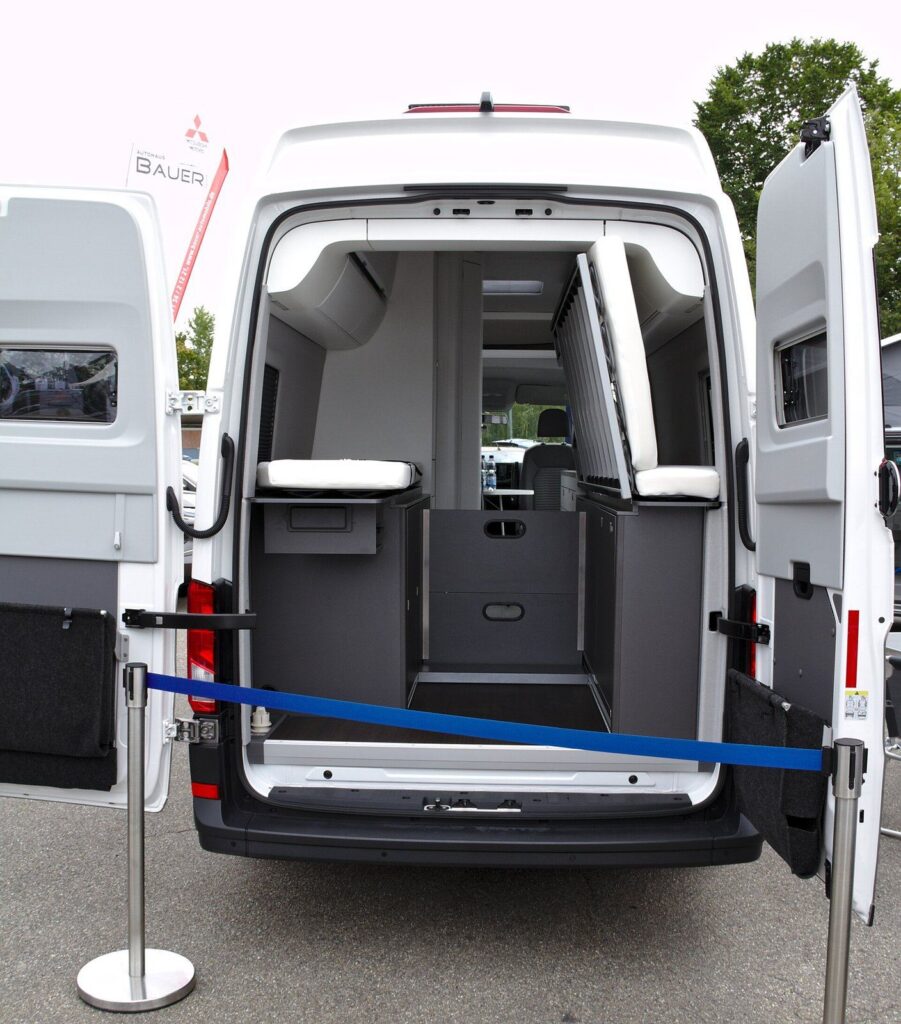 [Image: Rear doors open on a Crafter-based Volkswagen California XXL, showing the garage space and the bed platform folded up]
Photo: Alexander Migl, CC BY-SA 4.0, via Wikimedia Commons (https://commons.wikimedia.org/wiki/File:Volkswagen_California_XXL_Leonberg_2019_IMG_0071.jpg).
The factory Grand California is Crafter-based. Volkswagen says it has a two-person rear bed, transverse on the 600 and lengthways on the 680. The photo is a California XXL, a Crafter-based Volkswagen camper with the bed platform folded up over a garage. It is not a Grand California. We have not guessed the mattress size.Crash tests, seat belts and what the law actually says
If people sit on that bench while you drive, the bed is also a travel seat. This is guidance, not legal advice.
Do rock and roll beds have to be crash tested?
Not by law, if your camper started life as a van already registered with the DVLA. GOV.UK calls that idea a misconception. The converter must still produce a safe vehicle. Construction and Use Regulation 100, and Road Traffic Act 1988 section 40a, say you must carry passengers without causing danger. Extra seats also have to stay put in an accident.
New motor caravans on type approval or IVA are different. Those routes require a type-approved travel seat, including a seat that turns into a bed. A fixed bed needs no test. Do not use it while travelling. “M1 tested” or “pull tested” is trade shorthand for UN Regulations 14, 16 and 17. A certificate only covers that seat, on that base, in the fixing the test used. Count the belts, not the cushions. Tell your insurer about the conversion. A new body type on the V5C does not prove a test covers the bed. See our insurance guide (https://dubbedout.co.uk/latest-news/campervan-insurance-uk-explained-self-build-vs-motor-caravan/) and DVLA motor caravan guide (https://dubbedout.co.uk/latest-news/dvla-motor-caravan-pop-top-guide/).
Seat belts, children and ISOFIX
You must wear a belt if the seat has one, and only one person may sit in each belted seat. Children need the correct child seat until 135cm or their 12th birthday, whichever comes first. GOV.UK says there is no legal requirement to fit rear seat belts in a van.
A proper seat with belts is still the safest way to carry people. Children 12 or under must use a suitable restraint. You can use ISOFIX if the bench has the points and the child-seat maker confirms the fit. Do not use child seats on side-facing seats. A three-point belt and a compatible seat may still work if there is no ISOFIX. Check the instructions.
3/4 or full width, and what it does to the layout
A 3/4 bench leaves a walkway beside the bed, which is the usual choice with a side kitchen. A full-width bench seats more people and makes a wider bed, but you often climb over it to reach the boot. Makers differ, so we have not invented a single width for a generic rock and roll.
Measure the bed when you fold it flat. The official RIB widths above are a useful example. The bench is heavy, so check the maker’s weight rather than guessing, and count passengers as well as the furniture. Our payload guide (https://dubbedout.co.uk/latest-news/campervan-payload-explained/) at https://dubbedout.co.uk/latest-news/campervan-payload-explained/ and our T26 to T32 guide (https://dubbedout.co.uk/latest-news/t26-t27-t28-t30-t32/) at https://dubbedout.co.uk/latest-news/t26-t27-t28-t30-t32/ explain why that matters. Van size also changes the choice. See our T6 (https://dubbedout.co.uk/latest-news/vw-t6-buying-guide-uk/), T4 (https://dubbedout.co.uk/latest-news/buying-a-volkswagen-t4-news-copy/) and T25 buying guides (https://dubbedout.co.uk/latest-news/vw-t25-buying-guide-uk/) if you are still picking a base vehicle.
How many can sit, and how many can sleep?
Sleeping places and travelling seats are different numbers. A pop-top can add two berths without adding two belted seats. Do not travel more people than there are proper belted seats. Do not treat the roof or a fixed bed as a seat on the move. For a factory California, check the official “up to four” line against the exact layout.
Bottom line
Campervan beds explained simply: pick the setup that matches how you travel. Most Transporter-style vans you’ll see use a rock and roll or RIB bench. A pop-top roof bed is the extra berth, not an extra travel seat. A fixed bed suits a bigger van, such as a Crafter, once you can give up that folding seat. Comfort matters, but so do seat belts, payload, and an honest count of who can sleep and who can travel.
Got a bed setup the rest of us could learn from? Share it in the Dubbed Out Community on Facebook (https://www.facebook.com/groups/dubbedoutvwcampervanfestival). Join the newsletter at https://dubbedoutfestival.co.uk for early ticket access. Tickets go on sale through Ticket Tent on 31 January 2027.
Quick answers
Do rock and roll beds have to be crash tested?
Not by law if your camper started life as a van already registered with the DVLA. GOV.UK calls that a misconception, but the van still has to be safe. New motor caravans on type approval or IVA need a type-approved travel seat, including a seat that becomes a bed. Ask for the paperwork, and check it covers your van.
What is the difference between a RIB bed and a rock and roll bed?
A rock and roll is the classic folding bench: you sit and sleep on the same side of the cushions. A RIB bed from Scopema flips over so you sleep on the other face, which is why people call it flatter. Both can have seat belts. Some rock and roll beds have a test certificate too, and some do not.
How many people can sleep in a VW California?
Most factory Californias sleep up to four: two in the pop-top roof bed and two on the lower rear bench. That depends on the exact trim, because a simpler Beach layout may not have the same lower bed. Check the van. Sleeping places are not the same as belted travel seats.
Can you sleep in a pop-top in winter?
Yes, plenty of people do. A canvas roof is only a single layer, so it will be colder than the insulated body. Condensation likes the cold surface under the mattress. Use warm bedding, keep a little ventilation going, and dry the canvas before you pack the roof down.
Can I use ISOFIX in a campervan?
Yes, if the bench has ISOFIX points and the child-seat maker says that seat is compatible in that position. The same child-seat rules apply as in a car: the correct seat until 135cm or age 12. Do not fit child seats to side-facing seats. A three-point belt and a compatible seat may still work if there is no ISOFIX.
Can I use a rock and roll bed as a bed while driving?
No. While the van is moving it is a seat, and anyone on it should be sitting up, belted in, one person per belt. The bed only comes out once you park. A fixed bed is not a seat on the move either.
